Lumbar spinal stenosis occurs when the neural foramina or central spinal canal narrows, causing direct pressure or impingement on the lower back nerve roots. This condition is most commonly caused by age-related osteoarthritic changes, ligament thickening, or disc space narrowing.
Common symptoms include localized lower back discomfort, stiffness, and leg pain or heaviness during prolonged standing or walking (neurogenic claudication).
Related Reading: Ready to take control of your long-term health and functional mobility? Read our full guide: Get Strong After 40: Your Fitness Reset Begins Now.
While spinal stenosis is a chronic structural condition, targeted movement strategies can significantly reduce daily symptoms. By strengthening the deep abdominal wall and improving hip mobility, you can relieve unnecessary mechanical stress on the lumbar spine.
The Role of Core Stability in Spine Health
Managing stenosis symptoms requires a controlled, spine-sparing approach rather than aggressive or high-intensity conditioning. The primary goal of a post-physical therapy home program is to:
- Maintain Pelvic Neutral: Preventing excessive arching (hyperlordosis) in the lower back keeps the spinal canal as open as possible.
- Engage the Transverse Abdominis: The deep muscular girdle provides internal stabilization to protect sensitive nerve roots.
- Improve Hip Mobility: Tight hip flexors pull the pelvis forward into anterior tilt, which increases compression on the lumbar facets.
5 Essential Home Exercises for Stenosis
Perform these exercises slowly with strict attention to form. Never push through sharp, radiating, or worsening neurological pain.
1. Supine Abdominal Bracing with Marching
- Target Muscles: Transverse Abdominis, Internal Obliques, Deep Core
- Purpose: Teaches pelvic stabilization while moving the lower extremities.
-
How to Perform:
- Lie on your back on a firm surface with knees bent, feet flat on the floor, and arms at your sides.
- Gently pull your belly button toward your spine to brace your abdominal wall, keeping your lower back flat against the floor.
- Holding this brace, slowly lift one foot 2 to 3 inches off the floor.
- Lower the foot back down with control and repeat on the opposite side. Continue alternating.
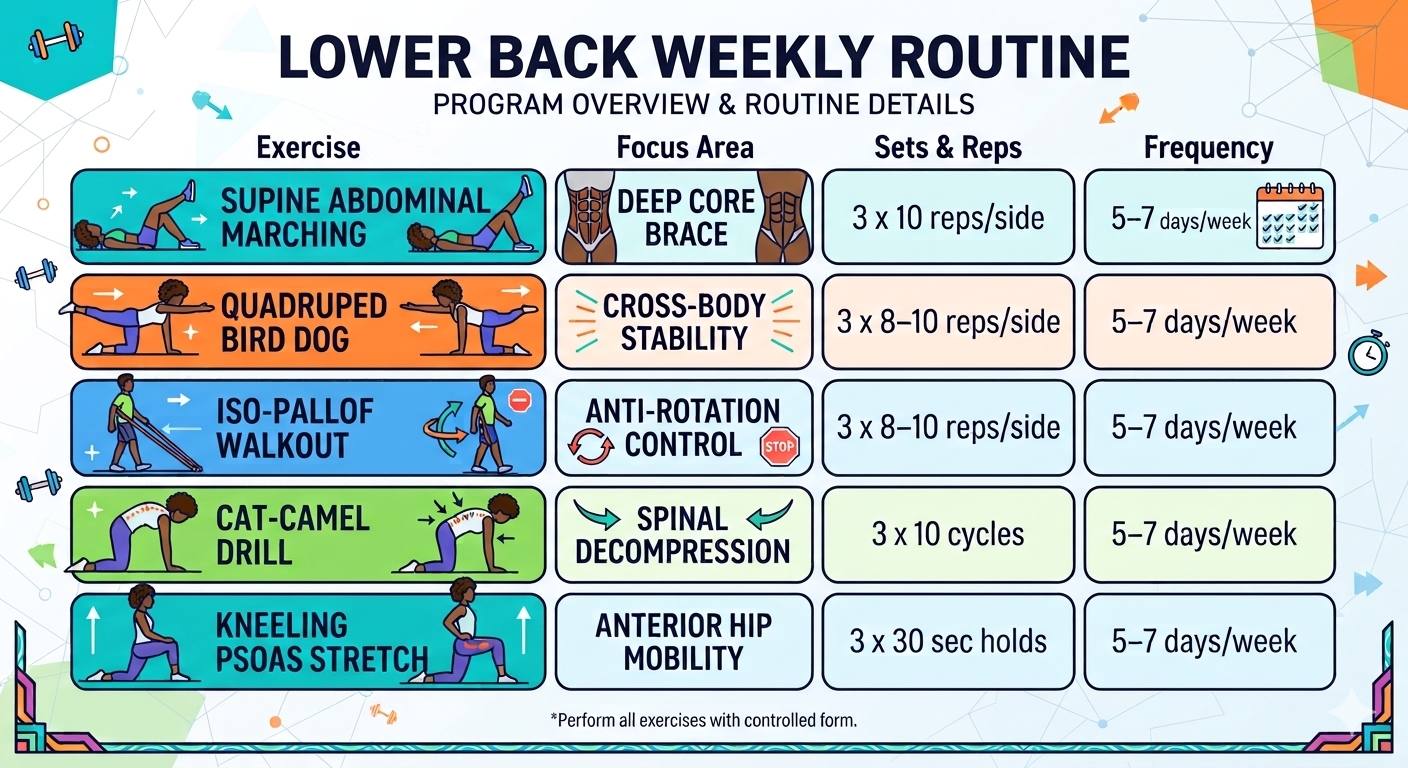
- Prescription: 3 sets of 10 repetitions per leg | Daily
2. Quadruped Bird Dog (Neutral Spine Hold)
- Target Muscles: Multifidus, Erector Spinae, Gluteus Maximus, Core Stabilizers
- Purpose: Builds cross-body rotational stability without loading the spinal column.
-
How to Perform:
- Position yourself on all fours with hands directly under your shoulders and knees under your hips.
- Engage your core to establish a flat, neutral back.
- Slowly extend your right arm forward and left leg backward until both are parallel to the floor.
- Hold for 1 to 2 seconds, then slowly return to the starting position without letting your torso tilt or sag. Repeat on the opposite side.
- Prescription: 3 sets of 8 to 10 repetitions per side | Daily
3. Standing Iso-Pallof Press & Walkout
- Target Muscles: Anti-Rotational Core, Glute Medius, Lumbar Stabilizers
- Purpose: Resists lateral and rotational forces to keep the spine stable during movement.
-
How to Perform:
- Anchor a light resistance band at chest height to a sturdy door frame or post.
- Stand perpendicular to the anchor point, holding the band handle with both hands pressed against your chest.
- Step away from the anchor point until you feel mild tension trying to pull your torso toward the post.
- Press the band straight out in front of your chest while maintaining a tall, upright posture. Hold for 2 seconds, retract to your chest, and slowly step back in.
- Prescription: 3 sets of 8 to 10 controlled walkouts per side | Daily
4. Cat-Camel Mobility Drill
- Target Muscles: Thoracolumbar Spine, Segmental Vertebral Mobilizers
- Purpose: Promotes gentle flexion and decompression of the posterior spinal elements.
-
How to Perform:
- Start on all fours with hands under shoulders and knees under hips.
- Cat Phase: Exhale, pull your abdominal wall inward, and slowly round your back upward toward the ceiling, letting your head drop gently. Hold for 3 to 5 seconds.
- Camel Phase: Inhale and slowly return your spine to a flat, neutral position. (Avoid arching deeply into extension, as excessive extension can narrow the spinal canal).
- Prescription: 3 sets of 10 slow cycles | Daily
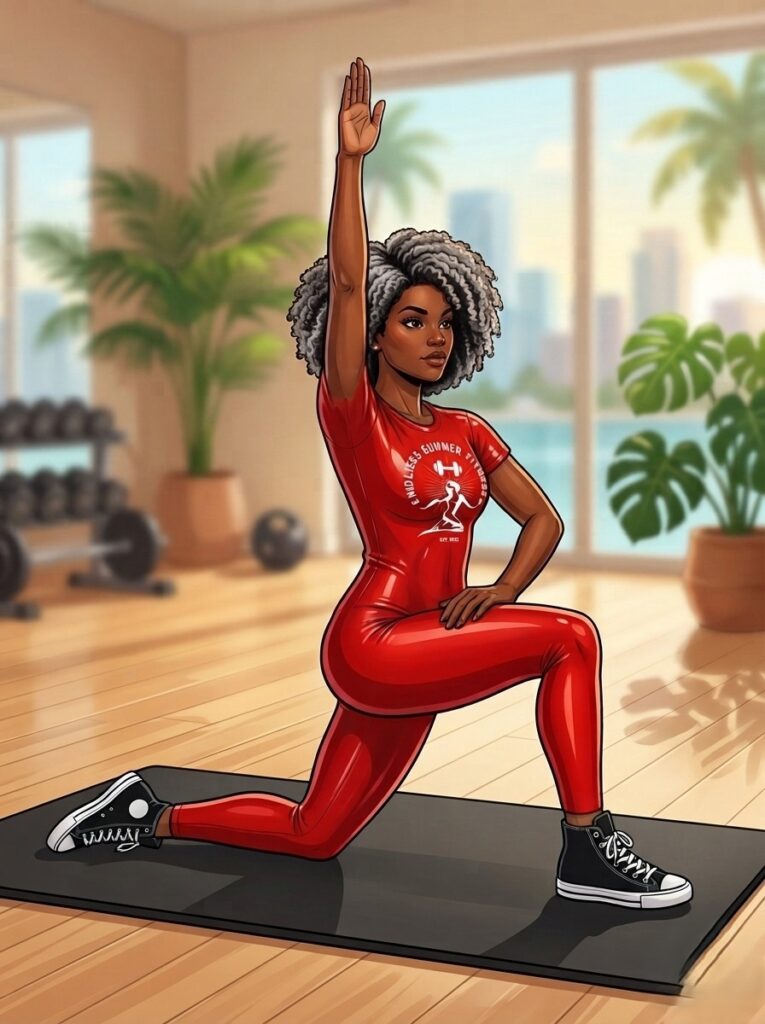
5. Kneeling Iliopsoas Hip Flexor Stretch
- Target Muscles: Iliopsoas, Rectus Femoris, Anterior Hip Capsule
- Purpose: Relieves tight hip flexors that pull the lumbar spine into painful extension.
-
How to Perform:
- Kneel on a cushioned mat on your right knee, placing your left foot flat in front of you with the knee bent at 90 degrees.
- Tuck your tailbone slightly under (posterior pelvic tilt) and squeeze your right glute.
- Gently shift your weight forward an inch or two until you feel a mild stretch in the front of your right hip. Do not arch your lower back.
- Hold the position for 30 seconds while breathing deeply, then switch sides.
- Prescription: 3 sets of 30-second holds per side | Daily
Implementation & Weekly Structure
Conclusion
Managing chronic conditions like lumbar spinal stenosis requires steady consistency, patient progression, and strict adherence to proper movement mechanics. By focusing on deep abdominal activation, pelvic alignment, and hip flexibility, you can build a resilient spinal support system directly from home. Work closely with your physical therapist or healthcare team to adjust these movements as your function and comfort improve.
References & Sources
-
Mayo Clinic Health Information
- Guideline: Lumbar Spinal Stenosis Diagnosis, Symptoms, and Conservative Management.
- Core Principle: Recommends physical therapy, flexion-based exercises, and core stabilization as primary non-surgical interventions.
- Source: Mayo Clinic Spinal Stenosis Resources
-
Arthritis Foundation
- Guideline: Managing Osteoarthritis and Spinal Canal Narrowing Through Movement.
- Core Principle: Supports targeted physical activity to maintain joint nutrition, muscular support, and functional independence.
- Source: Arthritis Foundation Physical Activity Guidelines
-
National Institutes of Health (NIH) / PubMed Central
- Study: Conservative Physical Therapy Interventions for Lumbar Spinal Stenosis: A Systematic Review.
- Core Principle: Demonstrates that deep abdominal bracing and hip flexor lengthening reduce lumbar lordosis and alleviate compressive root pain.
- Source: NIH National Library of Medicine
Medical Disclaimer: This article is for educational and informational purposes only and does not constitute medical advice. Always consult a physician, physical therapist, or qualified healthcare professional before beginning any new exercise program, especially if you suffer from chronic spinal conditions or active radicular pain.