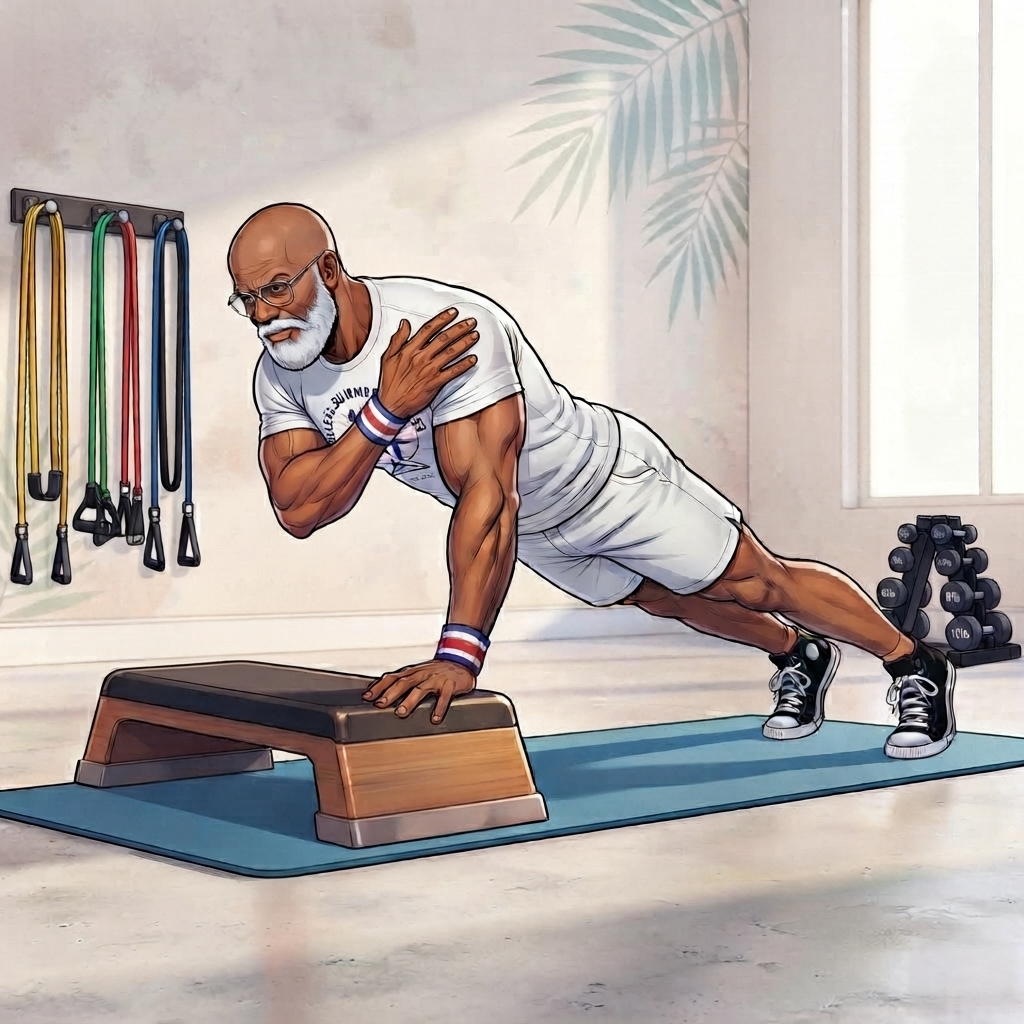
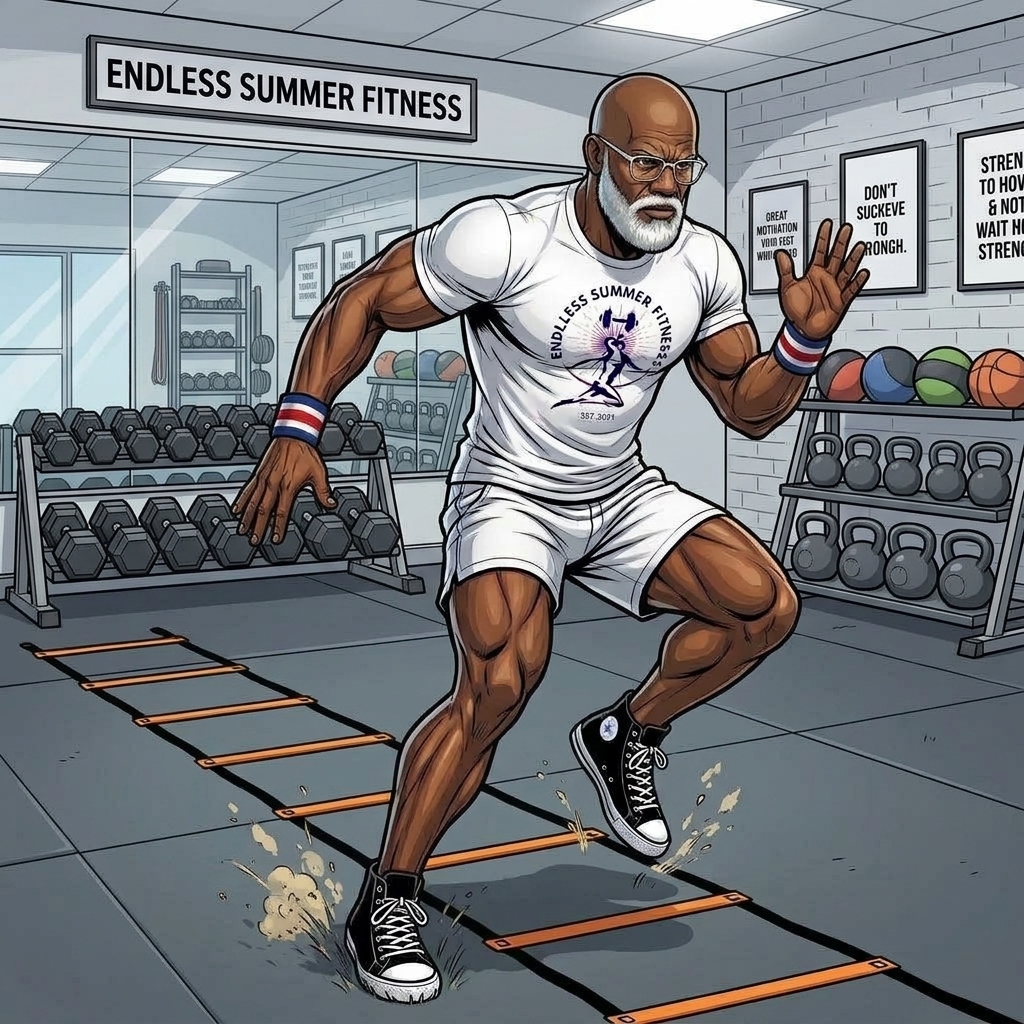
Agility ladders are one of the simplest ways for adults over 40 to rebuild dynamic balance, reactive stability, and multi‑directional confidence. Most daily movement stays in a straight line, walking, cycling, treadmill work, which limits the body’s ability to handle sideways shifts, diagonal steps, and quick changes in direction. Over time, that gap increases the risk of slips, stumbles, and awkward twisting forces.
Ready to build stronger, safer footwork? Continue your training with our guide to improving ankle mobility for better balance and joint resilience after 40.
Biomechanical Foundations for Longevity and Mobility
Ladder drills solve this by forcing precise foot placement inside a defined footprint. The central nervous system learns to coordinate foot speed, stride cadence, and spatial awareness while strengthening the stabilizers around the ankles, knees, and hips. The goal isn’t sprinting velocity. It’s clean mechanics, short ground contact time, and controlled movement.
Maintain a neutral spine, slight hip hinge, and keep your center of mass stacked over your midfoot. Land softly on the forefoot and avoid heavy heel strikes. The calves and Achilles handle impact best when posture stays aligned.
Physiology and Age‑Appropriate Recovery Protocols
Connective tissue adapts slower than muscle. Tendons and ligaments fatigue quickly and recover gradually, especially after 40. High‑impact jumping or daily ladder sessions overload these structures and lead to issues like plantar fasciitis or patellar tendinopathy.
A safe ladder schedule:
- 2–3 short sessions per week
- Stop immediately when coordination drops
- Technique first, speed second
Warm up with gentle dynamic movements: leg swings, controlled high knees, and light lunges. Save static stretching for the cooldown. Long holds before coordination work temporarily reduce responsiveness and slow reaction time.
9 Beginner‑Friendly Ladder Drills for Adults Over 40
Each drill is low‑impact, joint‑friendly, and designed to build confidence before progressing to faster patterns.
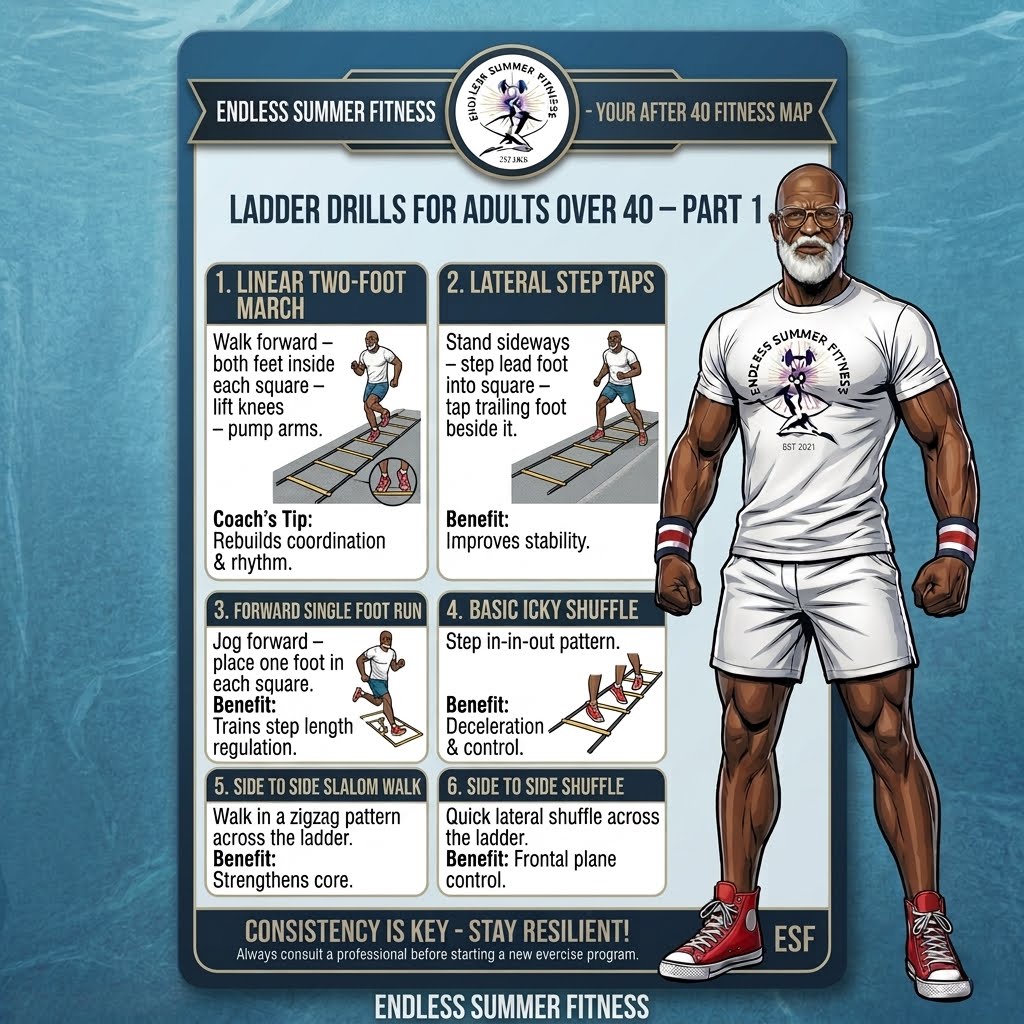
1. Linear Two‑Foot March
Walk forward, placing both feet inside each square. Lift the knees slightly and pump the arms. Benefits: Rebuilds basic coordination and rhythm.
2. Lateral Step‑Taps
Stand sideways. Step your lead foot into the square, then tap the trailing foot beside it. Benefits: Strengthens hip abductors and improves pelvic stability.
3. Forward Single‑Foot Run
Jog forward, placing one foot in each square with crisp, quick strikes. Benefits: Trains stride cadence and step‑length regulation.
4. Basic Icky Shuffle
Step in with the right foot, step in with the left, step out with the right. Repeat the 1‑2‑3 pattern. Benefits: Builds lateral agility and multi‑limb coordination.
5. Side‑to‑Side Slalom Walk
Step diagonally in and out of the squares in a smooth zigzag. Benefits: Introduces safe deceleration and strengthens frontal‑plane control.
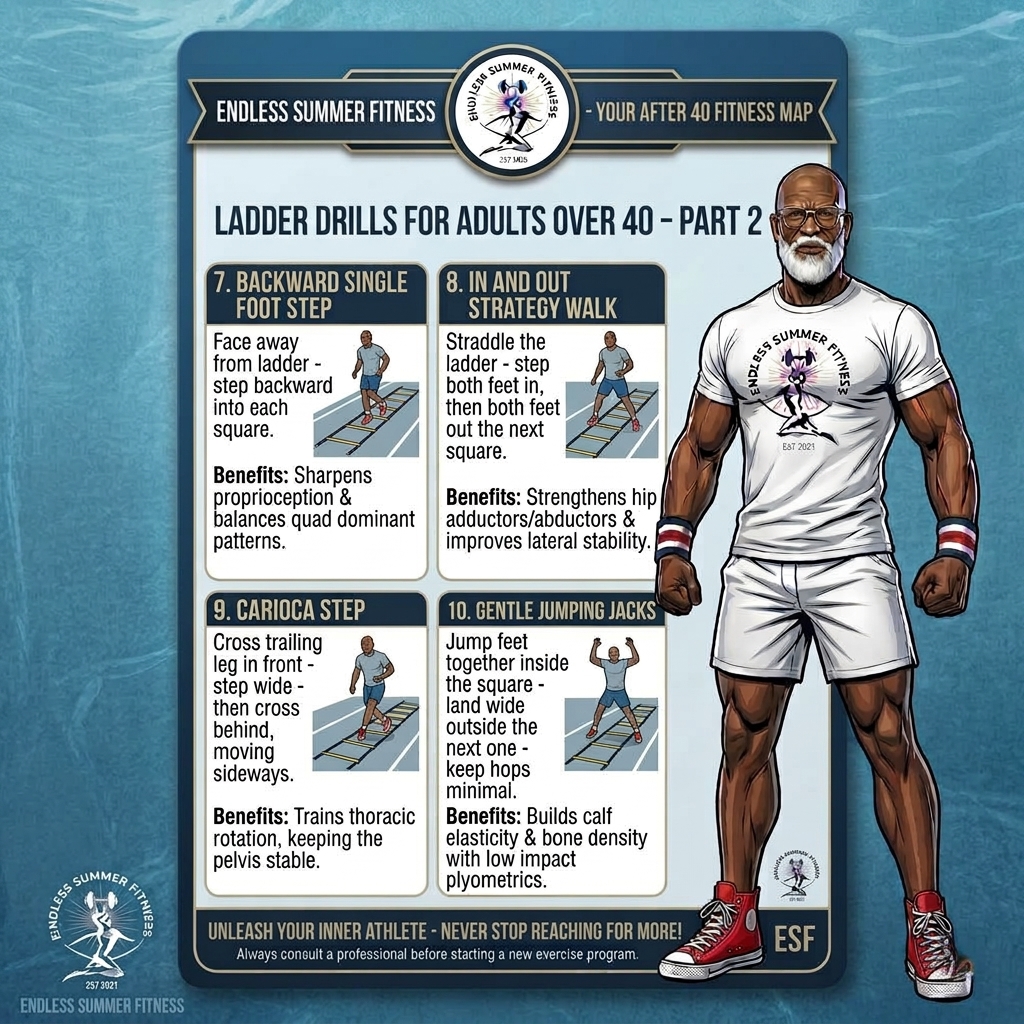
6. Backward Single‑Foot Step
Face away from the ladder and step backward into each square. Benefits: Sharpens proprioception and balances quad‑dominant patterns.
7. In‑and‑Out Strategy Walk
Start straddling the ladder. Step both feet inside, then both feet outside the next square. Benefits: Strengthens hip adductors/abductors and improves lateral stability.
8. Carioca Step
Cross the trailing leg in front, step wide, then cross behind as you move sideways. Benefits: Trains gentle thoracic rotation while keeping the pelvis stable.
9. Gentle Jumping Jacks
Jump feet together inside the square, then land wide outside the next one. Keep hops minimal. Benefits: Builds calf elasticity and bone density with low‑impact plyometrics.
Safe Progressions and Longevity Integration
Place ladder work at the start of your session, immediately after your dynamic warm‑up. Fatigue destroys coordination, so the nervous system must be fresh.
Start with two controlled passes per drill. Once a pattern feels automatic, increase difficulty by shifting your gaze forward instead of down. Training peripheral vision improves real‑world reaction time and movement confidence.
Medical Disclaimer: This article is for educational and informational purposes only and does not constitute medical advice. Always consult a physician or certified fitness professional before beginning a new exercise program, especially if you have pre-existing conditions.
References
Kumar, P., & Singh, A. (2020). The effects of agility ladder training on performance: A systematic review. Journal of Sports Science & Medicine, 19(2), 345–352. https://pubmed.ncbi.nlm.nih.gov/32396965/
Sánchez‑Muñoz, C., Sanz, D., & Zabala, M. (2020). Effects of training with an agility ladder on sprint performance. PeerJ, 8, e9471. https://pmc.ncbi.nlm.nih.gov/articles/PMC7386157/
Hernandez, A., & Schuerman, M. (2005). Neuromuscular coordination and balance control in aging populations. Journal of Gerontology: Biological Sciences, 60(7), 846–852. https://pubmed.ncbi.nlm.nih.gov/15905001/
Science for Sport Editorial Team. (n.d.). Are agility ladders a waste of time? https://www.scienceforsport.com/agility-ladders-waste-of-time/