

Fitness messaging often pushes an all-or-nothing mindset: spend hours on a treadmill or accept declining health. Modern exercise science tells a completely different story. Long, grueling sessions are rarely necessary or optimal for maintaining physical capacity, cardiovascular strength, and metabolic health.
Check this out: If stability is a challenge, start with Improve Ankle Mobility to build a stronger foundation
Interval training has emerged as one of the most thoroughly researched and effective fitness strategies available. By alternating controlled periods of active exertion with deliberate, structured rest, this training style conditions your heart, optimizes energy production, and builds systemic resilience in a fraction of the time required by traditional steady-state cardio.
With proper technique, controlled movement, and smart work-to-rest ratios, interval-based training delivers profound, measurable improvements in functional health.
The 7 Key Benefits
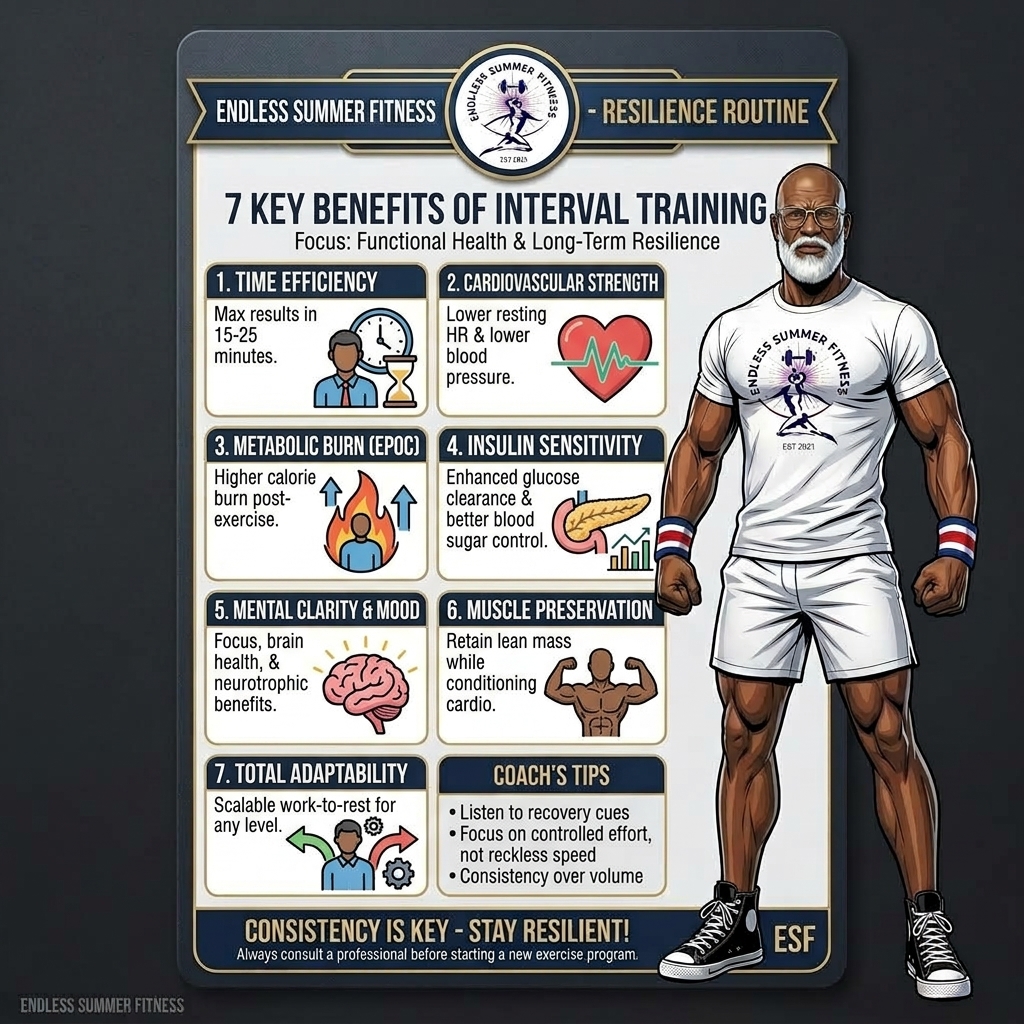
1. Superior Time Efficiency Without Overuse Strain
The single most common barrier to maintaining a consistent routine is time. Traditional aerobic conditioning often calls for 45 to 60 minutes of continuous effort. Controlled interval routines deliver comparable and, in many cases, superior cardiovascular and metabolic adaptations in 15 to 25 minutes.
By structuring workouts into short work blocks followed by recovery, you maximize output without causing systemic fatigue or excessive joint wear. For busy adults, this efficiency turns exercise from a time-consuming burden into an enjoyable, repeatable habit.
2. Enhanced Cardiovascular Capacity and Heart Health
Your cardiovascular system adapts to changing demands. Continuous, mid-intensity exercise trains the heart at a single pace, whereas interval training challenges your heart and lungs to adjust dynamically between higher demand and recovery.
This variable stimulus drives rapid improvements in stroke volume (the amount of blood the heart pumps per beat) and peak oxygen consumption (VO2 max). Regular interval work lowers resting heart rate, supports optimal blood pressure management, and improves arterial flexibility far more efficiently than walking or steady cycling alone.
3. Elevated Metabolic Rate (The Afterburn Effect)
One distinct physiological advantage of interval-based exercise is Excess Post-Exercise Oxygen Consumption (EPOC), commonly known as the “afterburn effect.”
When you shift between distinct effort levels, your body consumes additional oxygen post-workout to restore energy stores, clear metabolic byproducts, and repair tissue. This keeps your metabolic rate elevated for hours after your session, allowing your body to burn fuel efficiently long after you step off the floor.
4. Improved Blood Sugar Control and Insulin Sensitivity
Metabolic health relies heavily on how effectively your body processes glucose. During interval work, contracting skeletal muscles rapidly draw glucose from the bloodstream for immediate fuel, independent of insulin.
Consistently engaging in interval training increases insulin sensitivity and improves cellular glucose transport. This makes interval-based movement a frontline strategy for optimizing metabolic health, preventing insulin resistance, and managing blood sugar levels effectively as you age.
5. Preservation of Essential Lean Muscle Tissue
A major drawback of excessive, long-duration steady-state cardio is its tendency to break down lean muscle tissue for fuel over time. Preserving functional muscle mass is critical to support joint health, maintain metabolic speed, and prevent physical frailty.
Interval training relies on short, controlled bursts that recruit higher-threshold fast-twitch muscle fibers. This signal prompts your body to retain valuable lean tissue while conditioning the cardiovascular system, ensuring you build endurance without sacrificing strength.
6. Boosted Mental Clarity, Mood, and Stress Resilience
Physical conditioning extends far beyond your muscles and heart; it directly impacts your neurological health. Strategic interval work stimulates the release of endorphins and brain-derived neurotrophic factor (BDNF), a protein essential for brain health and cognitive function.
Structured work-and-rest intervals sharpen focus, elevate mood, and help regulate stress hormones like cortisol. Because workouts are brief and structured, you leave your session feeling energized and clear-headed, not drained for the rest of the day.
7. Full Adaptability Across All Movement Levels
The greatest strength of interval training is its complete versatility. You do not need extreme impact, heavy equipment, or high-speed sprinting to reap the full biological rewards. The core principle of interval work rests entirely on the relationship between effort and rest, not on absolute intensity.
You can adapt intervals using bodyweight exercises, incline walking, stationary cycling, rowing, or resistance bands. By adjusting the work-to-rest ratio (such as 30 seconds of controlled effort followed by 60 seconds of active recovery), you can tailor the stimulus to your fitness baseline while keeping joint safety paramount.
How to Structure a Safe, Effective Interval Routine
To execute interval training safely and maximize long-term health outcomes, follow these fundamental programming principles:
- Prioritize Controlled Work-to-Rest Ratios: Beginners and adults focusing on joint health should start with a 1:2 work-to-rest ratio (e.g., 20 seconds of controlled effort followed by 40 seconds of slow recovery) to ensure full heart rate recovery between sets.
- Focus on Quality Over Speed: Velocity should never come at the expense of form. Keep movements smooth, deliberate, and stable throughout each active interval.
- Keep Sessions Short: Limit active interval work to 15–20 minutes per session, 2 to 3 times per week. More is not better; quality stimulus and adequate recovery drive results.
External Sources:
-
High-Intensity Interval Training for Health and Fitness (PubMed / NIH)
- Focus: Examines clinical evidence supporting interval training for improving VO2 max, cardiovascular health, and metabolic regulation across diverse age groups.
-
Impact of Interval Training on Metabolic Health (PMC / NIH)
- Focus: Details the cellular and metabolic adaptations of interval-based exercise, highlighting improvements in insulin sensitivity, glucose management, and fat oxidation.
Medical Disclaimer: This article is for educational and informational purposes only and does not constitute medical advice. Always consult a physician or certified fitness professional before beginning a new exercise program, especially if you have pre-existing health conditions or joint concerns.
References
-
High-Intensity Interval Training for Health and Fitness (PubMed / NIH)
-
Focus: Examines clinical evidence supporting interval training for improving VO2 max, cardiovascular health, and metabolic regulation across diverse age groups.
-
-
Impact of Interval Training on Metabolic Health (PMC / NIH)
-
Focus: Details the cellular and metabolic adaptations of interval-based exercise, highlighting improvements in insulin sensitivity, glucose management, and fat oxidation.
-