If you are over 40 and looking for a strength routine that fits your body, your daily schedule, and your long-term movement goals, you are in the right spot.
Returning to strength training after 40 is not about rushing back to the heavy barbell lifts of your 20s. It is not about pushing yourself to complete exhaustion either.
It is about moving smarter, building reliable muscle, and protecting your joints. Most importantly, it is about recapturing the bright, athletic energy that keeps you active every single day.
Building Muscle Without Joint Wear and Tear
The physical reality is straightforward: a well designed dumbbell routine built for over 40 beginners delivers exceptional results. You can increase physical capacity, shape your physique, and improve total body balance without beating up your knees, hips, or shoulders.
The key lies in understanding how your body adapts over time and adjusting your training structure accordingly. That means prioritizing high volume, controlled movement tempos, smooth mobility, and exercises that offer maximum benefit with minimal wear and tear.
Key Takeaways
- Resistance training after 40 requires smart adjustments to exercise selection and movement speed, ensuring high adaptation without joint irritation.
- Multi joint dumbbell movements using strict tempo control (slow lowering phases) maximize muscular work while sparing connective tissue.
- Systematic progression through Beginner, Intermediate, and Advanced tiers allows you to build capacity safely as your movement confidence grows.
- Joint health relies on thorough dynamic warm ups, adequate hydration, and managing overall training volume rather than pushing to absolute failure.
- Visit the ESF Movement Library to explore additional joint friendly dumbbell variations tailored for your home or gym space.
The Exercise Physiology of Over 40 Movement
Your body at 40 or 50 does not adapt or recover the same way it did at 25. Acknowledging these physiological shifts is not a limitation—it is simply the baseline data needed to program effectively.
Outdated fitness myths often claim that adults over 40 must stick exclusively to low intensity cardio or high repetition machine work to prevent injury. Current exercise science debunks this. Resistance training remains mandatory for mitigating age related sarcopenia (muscle loss) and maintaining bone mineral density.
However, biomechanical demands do change as we age. Connective tissues experience structural alterations, including reduced collagen turnover and decreased elasticity. Tendons and ligaments adapt to mechanical load at a significantly slower rate than skeletal muscle tissue.
Additionally, age related reductions in synovial fluid production mean articular cartilage requires extra preparation before loading. Swapping explosive, rapid reps for strict tempo control—such as a 2 to 3 second eccentric (lowering) phase—increases time under tension to stimulate muscle growth while eliminating high impact forces on joint structures.
The 4 Essential Dumbbell Moves for Beginners
These four multi joint dumbbell exercises deliver the highest return on investment for over 40 bodies. They target every major muscle group while allowing your joints to move along natural, painless pathways.
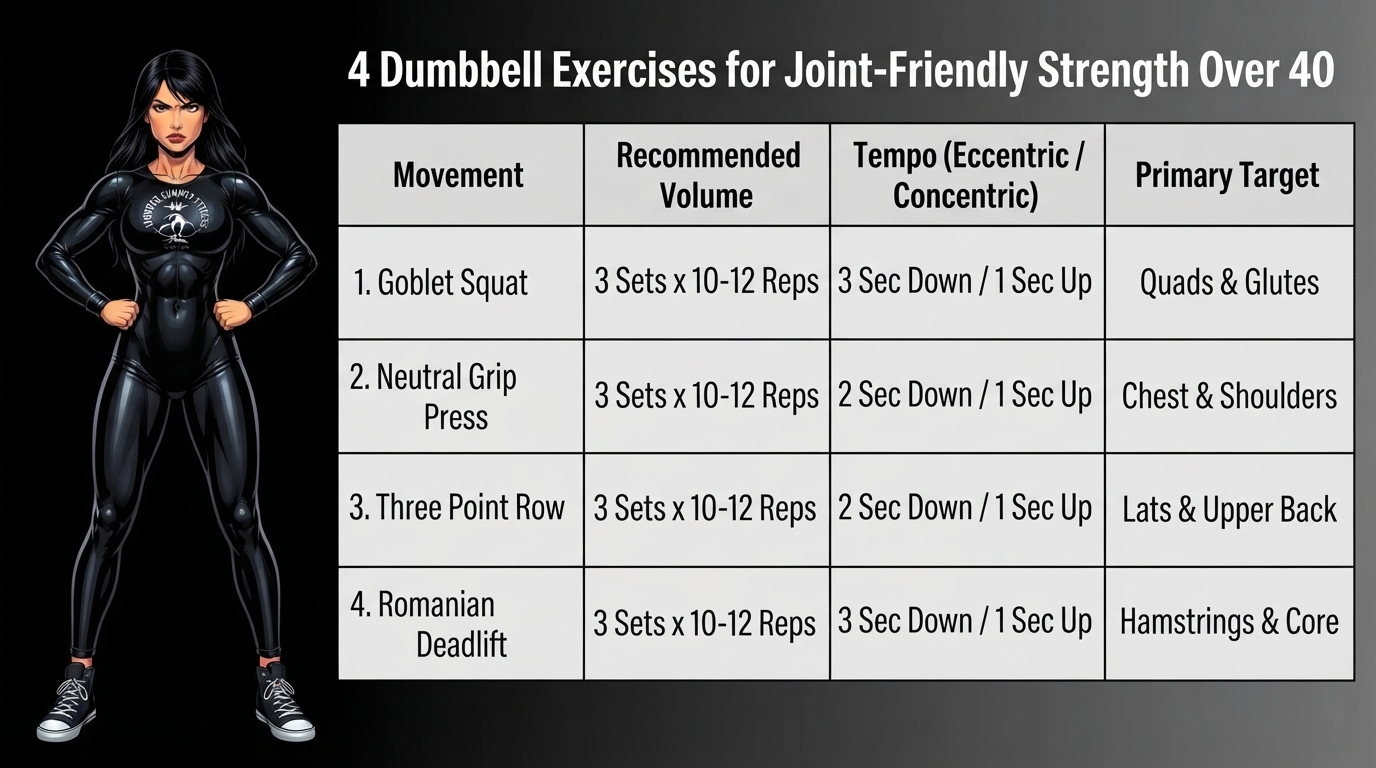
Move 1: The Dumbbell Goblet Squat
Holding a single weight vertically against your chest acts as a natural counterbalance. This keeps your torso upright and drastically reduces shear stress on the lower back compared to traditional back squats.
Step by Step Instructions:
- Stand tall with your feet slightly wider than shoulder width, holding one dumbbell vertically against your chest with both hands gripping the upper bell.
- Inhale deeply, brace your core, and lower your hips down and back as if sitting into a chair.
- Lower smoothly for 3 full seconds until your thighs are parallel to the floor, keeping your heels flat and elbows inside your knees.
- Press through your full foot to drive back up to the starting position.
Progression Path:
- Beginner: Bodyweight Chair Squat (lowering under control until glutes touch a sturdy seat).
- Intermediate: Standard Dumbbell Goblet Squat with a 3 second eccentric phase.
- Advanced: Goblet Squat with a 2 second isometric pause at the bottom of each rep.
Common Mistakes to Avoid:
- Rushing the Descent: Dropping quickly transfers load away from the muscles and directly into the knee tendons. Control the lowering phase.
- Heels Lifting: Keep your entire foot planted to distribute force evenly across your ankle, knee, and hip joints.
Preparation Tip: Review our ESF Ankle & Hip Mobility Guide for joint prep before squatting.
Move 2: Dumbbell Neutral Grip Bench Press
Pressing with your palms facing each other (a neutral grip) opens up the subacromial space in the shoulder joint. This protects the rotator cuff while building chest and triceps capacity.
Step by Step Instructions:
- Lie back on a flat bench (or flat on the floor for a Floor Press) holding a dumbbell in each hand at chest height, palms facing each other.
- Press the weights straight up over your chest without forcefully locking out your elbows at the top.
- Lower the weights under strict control over 2 seconds until your upper arms rest at a 45 degree angle to your torso.
- Pause briefly at the bottom, then press back up smoothly.
Progression Path:
- Beginner: Dumbbell Floor Press (restricting shoulder extension at the bottom).
- Intermediate: Flat Bench Dumbbell Neutral Grip Press.
- Advanced: Alternating Single Arm Dumbbell Press (demands increased anti rotational core stability).
Common Mistakes to Avoid:
- Flaring the Elbows: Allowing elbows to flare out at 90 degrees increases shoulder impingement risk. Keep them tucked closer to your sides.
- Bouncing at the Bottom: Releasing tension at the bottom eliminates muscular engagement and stresses joint capsules.
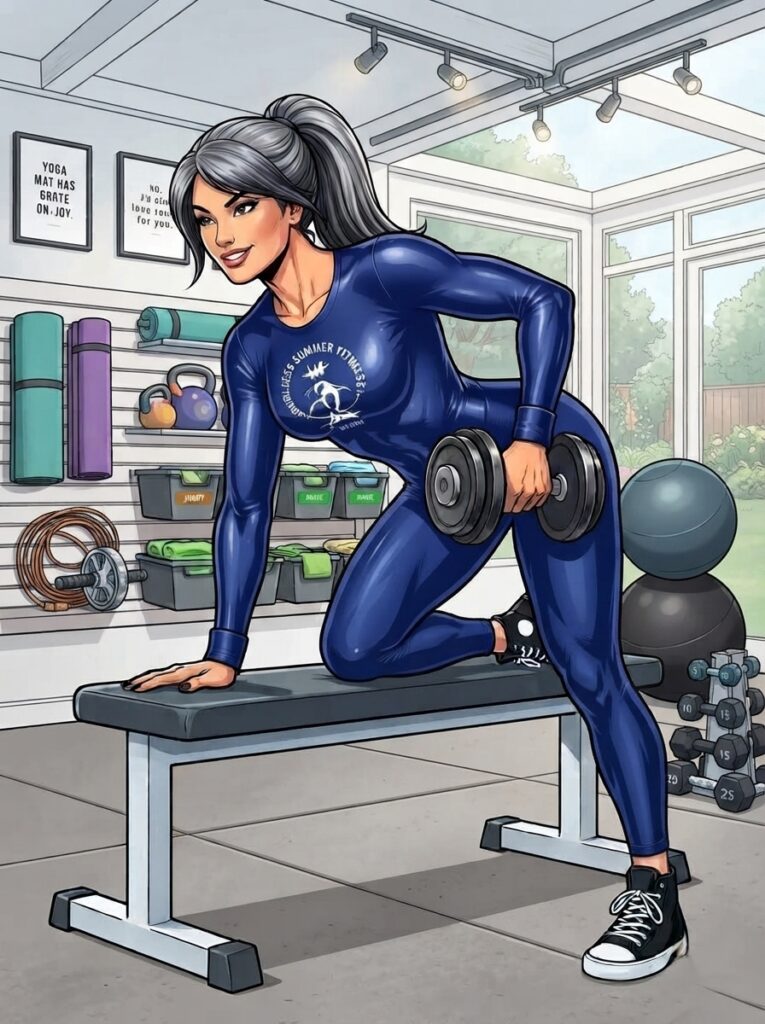
Move 3: Three Point Dumbbell Row
Supporting your non working hand and knee on a bench creates a stable three point base. This allows you to strengthen the upper back and lats with zero spinal strain.
Step by Step Instructions:
- Place your left knee and left hand firmly on a bench, keeping your torso parallel to the floor and spine flat.
- Hold a dumbbell in your right hand with a straight arm, keeping your shoulder square to the ground.
- Pull your right elbow up toward your hip, retracting your shoulder blade toward your spine at the top.
- Pause for 1 second at full contraction, then lower the weight smoothly over 2 seconds. Complete all reps on one side, then switch.
Progression Path:
- Beginner: Standing Chest Supported Row (resting your chest against an incline bench).
- Intermediate: Standard Three Point Dumbbell Row.
- Advanced: Single Arm Row in a standing staggered stance without bench support.
Common Mistakes to Avoid:
- Torso Rotation: Twisting your chest upward to move the weight reduces lat activation and subjects the lumbar spine to rotation under load. Keep shoulders square.
- Using Momentum: Jerking the weight removes time under tension. Use deliberate muscle control.
Preparation Tip: For postural alignment drills, explore our ESF Thoracic Rotation & Stability Guide.
Move 4: Dumbbell Romanian Deadlift (RDL)
The RDL reinforces the posterior chain (hamstrings, glutes, and spinal erectors) through a controlled hip hinge. Strengthening these muscles improves posture and protects the lower back during everyday activities.
Step by Step Instructions:
- Stand upright holding a dumbbell in each hand in front of your thighs, feet hip width apart and knees soft with a slight bend.
- Push your hips back toward the wall behind you while maintaining a neutral spine and broad chest.
- Lower the weights close to your legs for 3 seconds until you feel a comfortable stretch in your hamstrings (typically mid shin level).
- Drive your hips forward to return to standing, squeezing your glutes at full extension.
Progression Path:
- Beginner: Bodyweight Wall Touch Hinge (practicing pushing hips back to contact a wall).
- Intermediate: Standard Dumbbell Romanian Deadlift with controlled tempo.
- Advanced: Single Leg Dumbbell Romanian Deadlift (improves unilateral balance).
Common Mistakes to Avoid:
- Spinal Flexion: Allowing the back to round transfers load onto the intervertebral discs. Keep your chest open and spine neutral throughout.
- Excessive Knee Flexion: Turning the hinge into a knee dominant squat reduces hamstring loading. Keep knees soft but stationary as hips travel back.
Recovery & Joint Preservation Protocols
Exercise provides the adaptation stimulus, but recovery determines physical progress. Focus on these evidence based fundamentals:
- Hydration for Cartilage: Articular cartilage relies on extracellular water content for shock absorption. Maintain consistent hydration throughout the day.
- Protein Distribution: Over 40 bodies require higher single meal threshold doses of protein (30 to 40 grams) to effectively stimulate muscle protein synthesis.
- Planned De-load Weeks: Every 4 to 6 weeks, reduce overall volume and intensity by 40% for one week. This gives connective tissues and the central nervous system time to fully recover.
Do This Next
Pick two of the exercises above—such as the Goblet Squat and the Three Point Row. Perform 2 light warm up sets of 10 reps each, focusing specifically on a slow 2 to 3 second lowering phase.
Pay attention to how smooth and controlled your movement feels when joint strain is eliminated. You are rebuilding a strong, capable body built for life.
For complete routines, mobility protocols, and joint friendly training plans, check out our ESF Mobility Guides and ESF Hybrid Guides to keep your movement energized year round.
References & External Resources
For further review of the scientific guidelines and biomechanical research referenced in this guide, visit:
- American College of Sports Medicine (ACSM): Resistance training guidelines for adult populations are available at ACSM.org.
- National Academy of Sports Medicine (NASM): Corrective exercise frameworks and joint preservation models can be explored at NASM.org.
- Journal of Applied Physiology: Peer reviewed studies regarding tendon adaptation rates and connective tissue loading are available via the Journal of Applied Physiology.