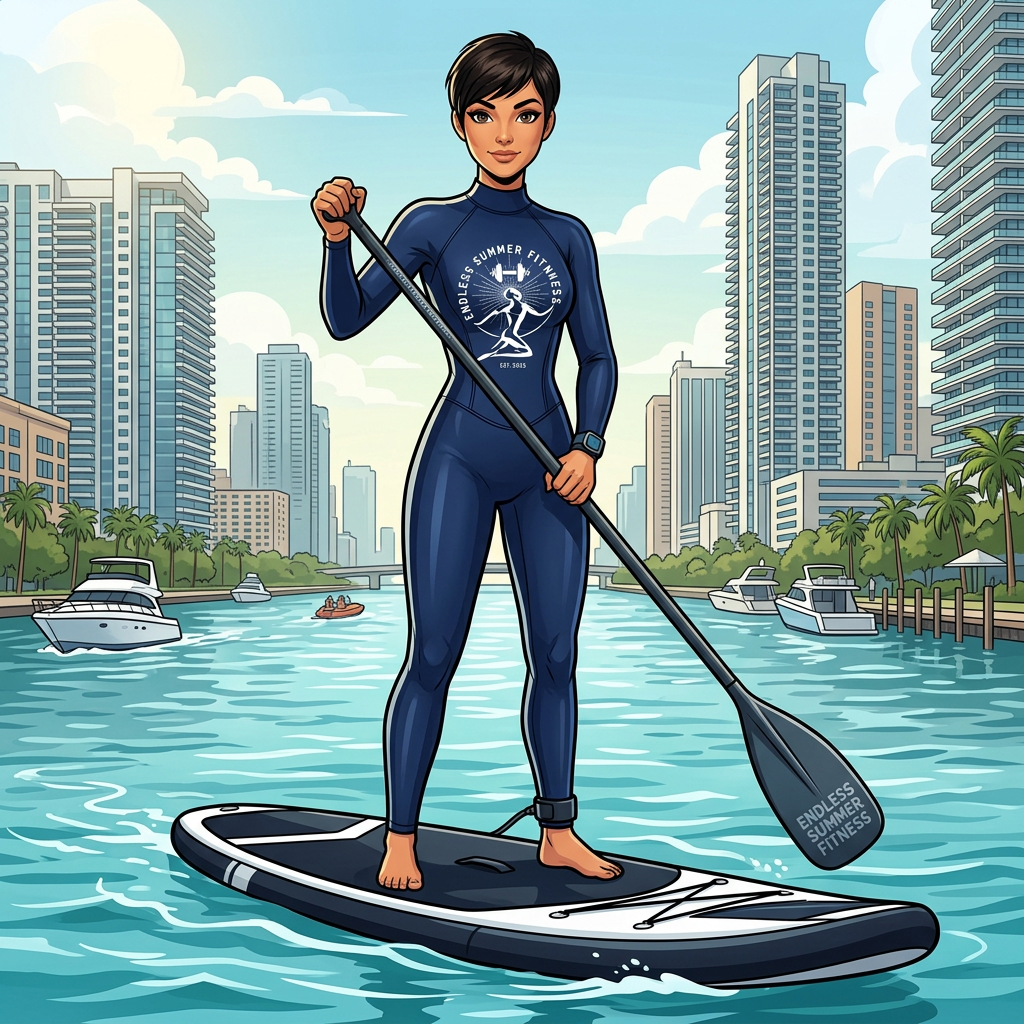
Stand-up paddleboarding in Miami is an unmatched experience. Warm water, bright sun, and that endless horizon make it feel like a mini-vacation. But here’s the secret: paddleboarding and functional exercises for paddleboarding are also one of the most underrated hybrid-fitness tools you can use.
Before you dive into the article, let me make one thing abundantly clear: I have never once paddlebaorded. Not because I don’t want to — but because my wife has a strict, non – negotiable ban on me standing on anything that floats, rolls, glides, or slides. That includes paddleboards, skateboards, surfboards, inline skates, roller skates, ice skates, kayaks, canoes, skis, and snowboards.
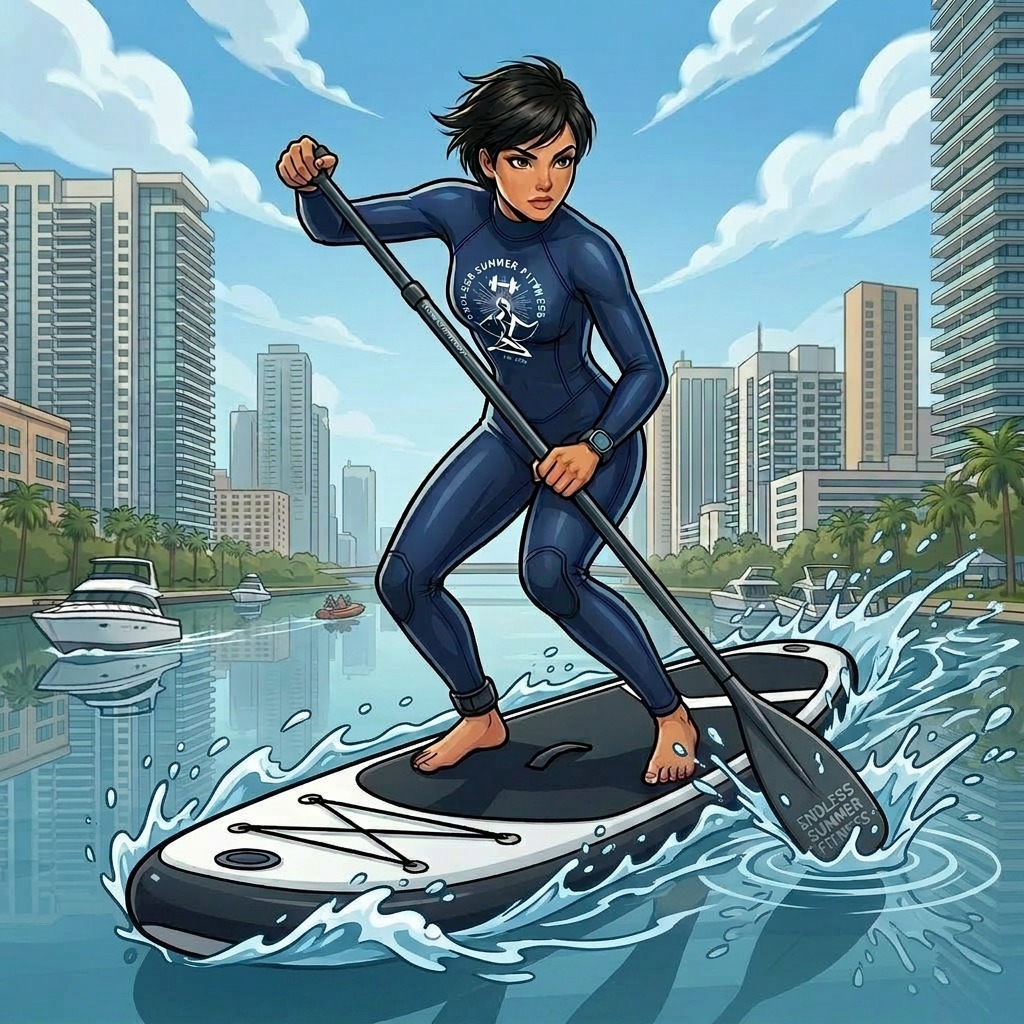
And yes— the earlier article’s images of me gleefully canoeing and kayaking on the Miami River are just an illustration. Pure fiction. Zero evidence exists that I’ve ever done any of those activities as an adult.
In my defense, I used to be an avid skateboarder, roller skater, and inline skater. I even went skiing once. My wife wasn’t there for any of it, but somehow my heroic adolescence war stories have failed to sway the jury.
Alright, now on to the article.
Paddleboarding: A Hybrid Athlete’s Secret Weapon
It builds strength, endurance, and functional movement that makes everyday life easier. And the best part? It’s fun, low-impact, and beginner=friendly — especially for busy professionals and anyone over 40 who wants to stay strong without beating up their joints.
Let’s break down why paddleboarding is a hybrid athlete’s dream.
What Makes Paddleboarding So Effective for Hybrid Fitness?
Paddleboarding blends strength, endurance, balance, and mobility in one smooth, rhythmic workout. According to Harvard Health, paddling sports strengthen the core, back, arms, and shoulders while improving stability and reducing the risk of injury. (“Paddling sports help tone muscles that make everyday movements easier with less chance of injury.” — Harvard Health)
On a paddleboard, every stroke forces your body to react to shifting water. That means your muscles must stabilize, rotate, and adapt — just like real life.
This is functional fitness in its purest form. And because Miami’s water stays warm year-round, you can train outdoors in a way that supports mental health, lowers stress, and boosts mood.
How Does Paddleboarding Improve Everyday Functional Strength?
Functional strength is the ability to move through daily life with ease—lifting groceries, climbing stairs, getting off the floor, carrying luggage, or reaching overhead.
Harvard’s functional fitness research shows that training multiple muscle groups at once improves balance, mobility, and confidence. (“Functional fitness improves your ability to carry out daily activities more easily and more confidently.” — Harvard Health)
Paddleboarding trains:
- Core rotation
- Hip stability
- Shoulder strength
- Grip endurance
- Balance and foot control
- Spinal mobility
These are the exact qualities that help you stay active, independent, and pain-free as you age.
Which Muscles Does Paddleboarding Work?
Paddleboarding is a full-body workout, but four areas do the heavy lifting:
1. Core
Rectus abdominis + obliques.
These muscles rotate, stabilize, and transfer power from your hips to your paddle.
2. Back
Lats + erector spinae.
They protect your spine and generate pulling strength.
3. Shoulders & Arms
Deltoids +biceps+ triceps.
Every stroke is a controlled pull-push pattern.
4. Hips & Feet
Glutes + deep foot stabilizers.
They keep you balanced on an unstable surface.
This combination builds a strong, athletic body that moves well in every direction.
Is Paddleboarding Good for Beginners and Busy Professionals?
Without question.
Paddleboarding is:
- Low-impact
- Easy to learn
- Joint-friendly
- Time-efficient
- Mentally refreshing
- Great for stress relief
You can get a full workout in 20–30 minutes, making it perfect for busy schedules.
And because Miami’s coastline is calm in the mornings, beginners can learn quickly without fear.
How Paddleboarding Fits Into Hybrid Training
Hybrid athletes train for strength + endurance. Paddleboarding checks both boxes:
Strength Training Pillar
Every stroke is a controlled pull powered by your core and back.
Endurance & Sprinting Pillar
You can paddle slow for Zone 2, moderate for tempo, or fast for VO₂ max bursts.
Food for Every Goal
Stand-up paddleboarding sessions burn calories, improve insulin sensitivity, and pair well with high-protein recovery meals.
Mindset Pillars
Paddleboarding reinforces:
• Patience — learning technique.
• Commitment — showing up consistently.
• Discipline — maintaining from.
• Enjoyment — the Miami water sells itself.
What Heart Rate Zones Should You Use on the Water?
Paddleboarding naturally fits into the 5-Zone Model:
- Zone 1 (Active Recovery): Easy paddling, warm-ups.
- Zone 2 (Aerobic Endurance): Steady cruising — best for fat oxidation.
- Zone 3 (Tempo): Moderate effort, great for conditioning.
- Zone 4 (Threshold): Hard intervals, short bursts.
- Zone 5 (VO₂ Max): Sprint paddling for 10-20 seconds.
MAF 180 Formula
For beginners or over-40 athletes, use:
180 – your age = max aerobic heart rate
This keeps you in a safe, sustainable Zone 2 range.
What Should You Eat and Drink Before Paddleboarding?
Hydration
Use electrolytes: sodium, potassium, magnesium.
Coconut water + citrus + sea salt works great.
Fuel
Carbs for energy.
Protein for muscle repair.
Healthy fats for long sessions (avocado, nuts, salmon).
Recovery
- 25-36g protein.
• 3-4g leucine threshold.
• Anti-inflammatory foods: berries, greens, ginger, tart cherry. • Mobility work to reduce stiffness.
The 5 Best Hybrid Fitness Exercises for Paddleboarders
-
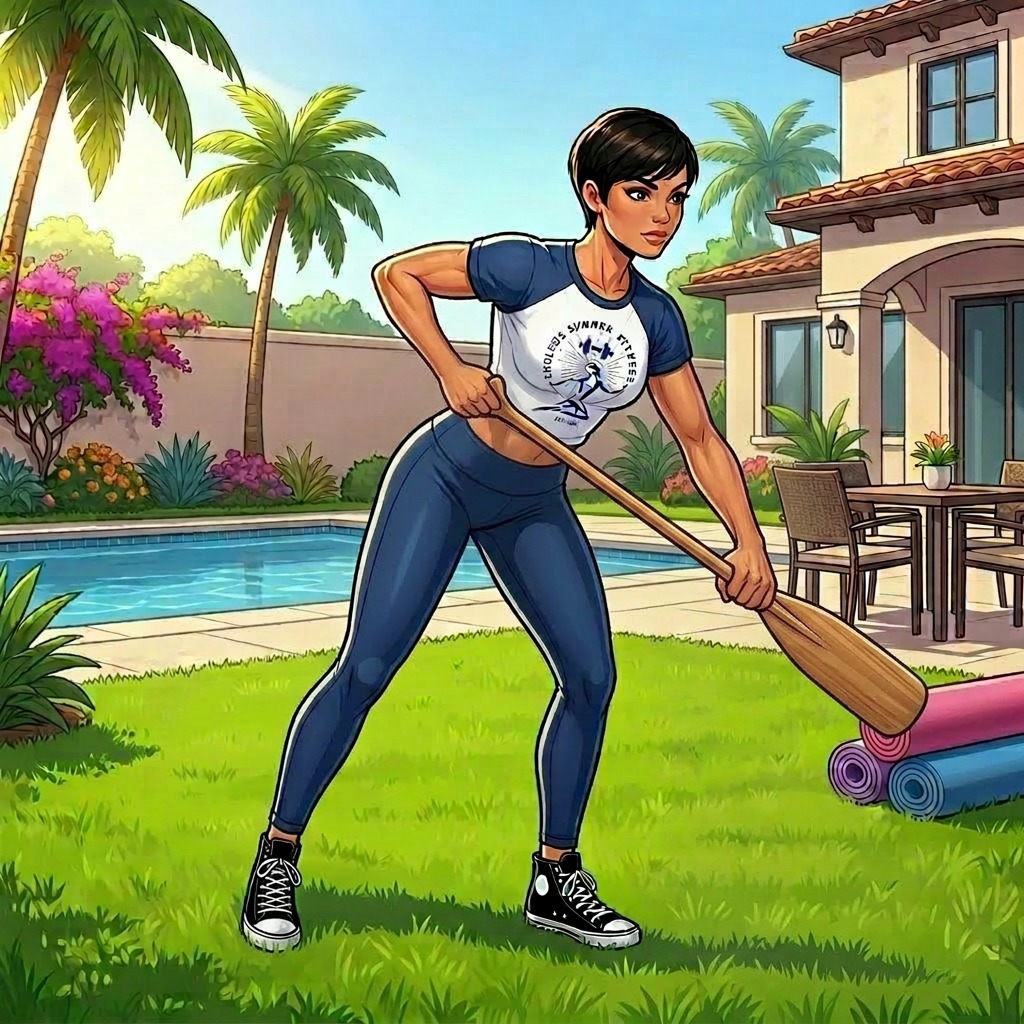
Standing Paddle Stroke (Land Drill)
Why it helps: Teaches rotation and power.
Muscles worked: Lats, obliques, delts.
Stabilizers: Glutes, deep core.
Hybrid benefit: Builds strength and endurance for long paddles.
OpenArt Prompt: Athlete practicing paddle stroke on land with resistance band, Miami vibe.
Alt Text: Land-based paddle stroke drill for hybrid athletes.
-
Split‑Stance Cable Row
Why it helps: Mimics paddle pulling mechanics.
Muscles worked: Lats, rhomboids, biceps.
Stabilizers: Hips, core.
Hybrid benefit: Improves power per stroke.
OpenArt Prompt: Athlete performing split-stance cable row, bright Miami gym.
Alt Text: Split-stance row building paddle power.
-
Single‑Leg RDL
Why it helps: Improves balance and hip stability.
Muscles worked: Hamstrings, glutes.
Stabilizers: Feet, core.
Hybrid benefit: Better board control.
OpenArt Prompt: Athlete doing single-leg RDL on the beach at sunrise.
Alt Text: Single-leg RDL for paddleboard balance.
-
Tall‑Kneeling Anti‑Rotation Press
Why it helps: Builds rotational control.
Muscles worked: Obliques, transverse abdominis.
Stabilizers: Glutes, lats.
Hybrid benefit: Protects the spine during paddling.
OpenArt Prompt: Athlete performing Pallof press with ocean backdrop.
Alt Text: Anti-rotation press for paddleboard core strength.
-
Farmer Carry
Why it helps: Builds grip, posture, and real‑world strength.
Muscles worked: Forearms, traps, core.
Stabilizers: Hips, feet.
Hybrid benefit: Improves endurance and stability on the board.
OpenArt Prompt: Athlete walking with kettlebells along Miami waterfront.
Alt Text: Farmer carry for grip and posture strength.
————————————————
Additional ESF Reading:
Summary
Paddleboarding blends strength, endurance, and functional movement into one smooth, enjoyable workout. It trains the core, back, shoulders, hips, and stabilizers in a way that supports everyday life — from lifting groceries ot climbing stairs to staying active as you age.
Because the water constantly shifts, your body must adapt with every stroke. This builds balance, mobility, and resilience. According to Harvard Health. Paddling strengthens the muscles you rely on for daily movement, which also helps cut down your chances of getting hurt.
Hybrid athletes benefit even more. Paddllebaording fits perfectly into Zone 2 endurance training, tempo work, and even VO₂ max intervals. It also reinforces the Endless Summer Fitness foundation: patience, commitment, discipline, and enjoyment.
Whether you’re a beginner, a busy professional, or someone over 40 looking for a joint-friendly workout, paddleboarding delivers a powerful, low-impact training experience.
FAQs
-
Is paddleboarding good for beginners?
Absolutely it is! Calm Miami mornings on the water make learning easy.
-
Does paddleboarding build muscle?
It strengthens your core, back, shoulders, and stabilizers.
-
How long should a paddleboarding workout be?
20–45 is enough for strength and endurance benefits.
-
Can paddleboarding help with weight loss?
Yes. It burns calories while improving insulin sensitivity.
-
Is paddleboarding safe for people over 40?
Affirmative. It’s low-impact and joint-friendly.
-
What heart rate zone should I train in?
Most sessions should be in Zone 2 using the MAF 180 formula.
Medical Disclaimer:
This article is for educational and informational purposes only and does not constitute medical advice. Always consult a physician or certified fitness professional before beginning a new exercise program, especially if you have pre-existing conditions.
Move fast, stay strong, go far
— The hybrid body is built for anything!
————————————————
Clinical / Medical Sources
Harvard Health Publishing — Paddle Sports & Functional Fitness
Grab Your Paddle (Harvard Health)
https://www.health.harvard.edu/staying-healthy/grab-your-paddle (health.harvard.edu in Bing)
Functional Fitness (Harvard Health)
https://www.health.harvard.edu/staying-healthy/functional-fitness (health.harvard.edu in Bing)
ACSM Guidelines
ACSM Physical Activity Guidelines
https://www.acsm.org/education-resources/trending-topics-resources/physical-activity-guidelines (acsm.org in Bing)
ACSM Position Stands (Strength, Endurance, Older Adults)
https://www.acsm.org/education-resources/position-stands (acsm.org in Bing)
PubMed — Core Stability & Functional Training Research
Core Stability & Athletic Performance (PubMed)
https://pubmed.ncbi.nlm.nih.gov/19996770/ (pubmed.ncbi.nlm.nih.gov in Bing)
Functional Training & Movement Quality (PubMed)
https://pubmed.ncbi.nlm.nih.gov/23838981/ (pubmed.ncbi.nlm.nih.gov in Bing)
Performance / Strength Sources
NSCA — Rotational Strength & Endurance
NSCA Performance Articles (Rotation, Power, Endurance)
https://www.nsca.com/education/articles/
NSCA Position Stand: Resistance Training for Older Adults
https://www.nsca.com/contentassets/7f1e3e3e8b8f4a2e8e8f4a2e8e8f4a2e/position-stand-older-adults.pdf (nsca.com in Bing)
(PDF — widely cited)
NASM — Balance, Stabilization, Movement Quality
NASM OPT Model — Stabilization & Balance Training
https://blog.nasm.org/opt-model-stabilization-endurance-training (blog.nasm.org in Bing)
NASM: Mobility & Stability Joint Functions
https://blog.nasm.org/mobility-and-stability-joint-functions (blog.nasm.org in Bing)
Nutrition & Recovery Sources
JISSN — Protein Intake & Leucine Threshold
JISSN Position Stand: Protein & Exercise
https://jissn.biomedcentral.com/articles/10.1186/s12970-017-0177-8 (jissn.biomedcentral.com in Bing)
Leucine Threshold & Muscle Protein Synthesis
https://jissn.biomedcentral.com/articles/10.1186/1550-2783-11-20 (jissn.biomedcentral.com in Bing)
AJCN — Anti‑Inflammatory Foods
Anti‑Inflammatory Dietary Patterns (AJCN)
https://academic.oup.com/ajcn/article/106/2/465/4633961 (academic.oup.com in Bing)
Omega‑3 Fatty Acids & Inflammation (AJCN)
https://academic.oup.com/ajcn/article/83/6/S1505/4633261 (academic.oup.com in Bing)
Electrolytes & Hydration Research
Electrolyte Balance & Hydration (Nutrients Journal)
https://www.mdpi.com/2072-6643/12/9/2834 (mdpi.com in Bing)
Hydration & Performance (PubMed)
https://pubmed.ncbi.nlm.nih.gov/30074923/ (pubmed.ncbi.nlm.nih.gov in Bing)