
Most beginner fitness advice is garbage. It either treats you like a fragile egg or assumes you’re training for a decathlon next month. Hybrid training sits somewhere in the middle. It blends strength work with conditioning. That idea has real science behind it. But the way most articles explain it? Vague. The way most programs apply it? Sloppy. In this article we explain hybrid training for beginners, what works and what to skip.
Here’s what you actually need to know. You’re not a bobsled athlete. You’re a person who wants to feel capable. The plan should match that reality.
What Hybrid Training Really Means
Hybrid training combines strength and endurance work in one program. Researchers call it concurrent training. The concept is sound. The details are where people get lost.
Here’s the uncomfortable truth. Strength training and endurance training send conflicting signals to your muscles. Endurance work activates AMPK (Adenosine 5′-monophosphate-activated protein kinase, which is like a smart “battery gauge” inside your body’s cells), an enzyme that can blunt the muscle-building pathway called mTOR .
Do too much cardio at the wrong time and your strength gains suffer. Do it in a reasonable dose and the interference stays small. The research on this is nuanced. For health purposes, the interference effect is far less of a concern than it is for competitive athletes .
The goal is not to exhaust yourself. Most beginners don’t need more intensity. They need more consistency and joints that still feel good next month.
The Recovery Rule You Probably Ignore
After 40, recovery slows down. Muscle protein synthesis declines with age. Studies show older lifters benefit from reduced training volume and more rest days to let tissues actually repair . That means three sessions per week, not six. That means at least one full day between hybrid workouts.
Skip this rule and you’ll be sore, tired, and quitting by week four. The people who stick with training for years are not the ones who went hardest at the start. They’re the ones who left the gym feeling like they could do it again tomorrow.
Strength Work That Respects Your Joints
Push-ups and goblet squats are fine. But most beginners need to start with positions that don’t punish their shoulders or lower back.
Dumbbell Floor Press
A safer alternative to the bench press. The floor stops your elbows before they travel too far below your torso. That reduced range means less stress on the front of your shoulder. You still train your chest and triceps. You just don’t pay for it the next day.
Execution: Lie on your back, knees bent, feet flat. Hold dumbbells at chest level with elbows bent. Press up until arms are straight. Lower until your upper arms touch the floor. Three sets of eight to twelve.
Coaching Tip: Press your shoulders down into the floor as you push. If your lower back arches off the ground, lighten the weight.
Split Squats
Better than lunges for most people over 40. Less balance demand. More control. Your front leg does the work while your back leg acts as a kickstand.
Execution: Step one foot forward. Lower your back knee toward the floor. Keep your front shin roughly vertical. Push through the front foot to stand. Three sets of eight per leg.
Coaching Tip: Hold a wall or chair if you wobble. That’s not weakness. That’s smart training.
Conditioning That Doesn’t Beat You Up
Jumping lunges and burpee tuck jumps have no place in a beginner program. High-impact repetitive work day after day is a recipe for cranky knees and a sore lower back. Your conditioning should elevate your heart rate without making your joints file a complaint.
Kettlebell Swings (Light, Controlled)
The swing is a hip hinge, not a squat. It builds posterior chain strength and gets your heart rate up fast. Research shows it’s effective for both power and aerobic capacity . But only if you learn the hinge first.
Execution: Stand with feet shoulder-width, kettlebell on the floor in front of you. Hinge at your hips and grip the handle. Hike the bell back between your legs. Snap your hips forward to swing it to chest height. Let it fall back as you hinge. Three sets of ten.
Coaching Tip: This is not an arm exercise. Your arms are ropes. The power comes from your hips snapping forward. If your lower back feels it, you’re doing it wrong.
Step-Outs
A lateral step into a shallow squat. No jumping. Keeps the heart rate up without pounding your knees.
Execution: Step out to the side. Sink into a quarter squat. Push back to center. Alternate. Three sets of twenty total steps.
Coaching Tip: If your knees cave inward, slow down. Push the knee out over the middle of your foot.
Conditioning Block: Pick Your Engine
Here’s where most home training plans fall apart. They give you burpees and call it cardio. Or they skip conditioning entirely and pretend strength work covers it. Neither is true hybrid training.
Your cardio doesn’t need to be fancy. It needs to be something you’ll actually do twice a week without dreading it. Walking, cycling, swimming, skating, or short sprint repeats all work. Pick one. Rotate them if you get bored. The best cardio is the kind you don’t skip.
One rule before you start: do your strength work first. A 2018 meta-analysis in Sports Medicine found that resistance training followed by endurance work produced better lower-body strength outcomes than the reverse order . Flip it around and your heavy sets pay the price. Strength first. Cardio second. That’s the sequence.
Option 1: The Endurance Walk (30–40 Minutes)
Walking is criminally underrated. The American Heart Association recommends at least 150 minutes of moderate aerobic activity per week for adults . A brisk walk fits that bill without hammering your joints.
Execution: Walk at a pace where you can hold a conversation but wouldn’t want to sing. If you’re gasping, slow down. If you’re strolling, pick it up. Thirty to forty minutes. Twice per week on your non-strength days.
Coaching Tip: Incline matters more than speed. A moderate hill walk beats a flat fast walk for heart rate and glute engagement. Treadmill incline at 8–10 percent works fine. So does a neighborhood hill.
Option 2: Cycling (25–35 Minutes)
Cycling gives you cardio without pounding. Your knees and lower back stay happy. Research on adults over 40 consistently lists biking as a joint-friendly aerobic option that supports heart health and lower-body endurance.
Execution: Stationary bike or actual bike. Moderate resistance. Cadence around 80–90 RPM. Twenty-five to thirty-five minutes. You should finish sweaty but not destroyed.
Coaching Tip: Don’t crank the resistance and grind at 50 RPM. That’s a strength workout disguised as cardio, and it’ll fry your quads before your heart gets much benefit. Spin faster, push moderately.
Option 3: Swimming (20–30 Minutes)
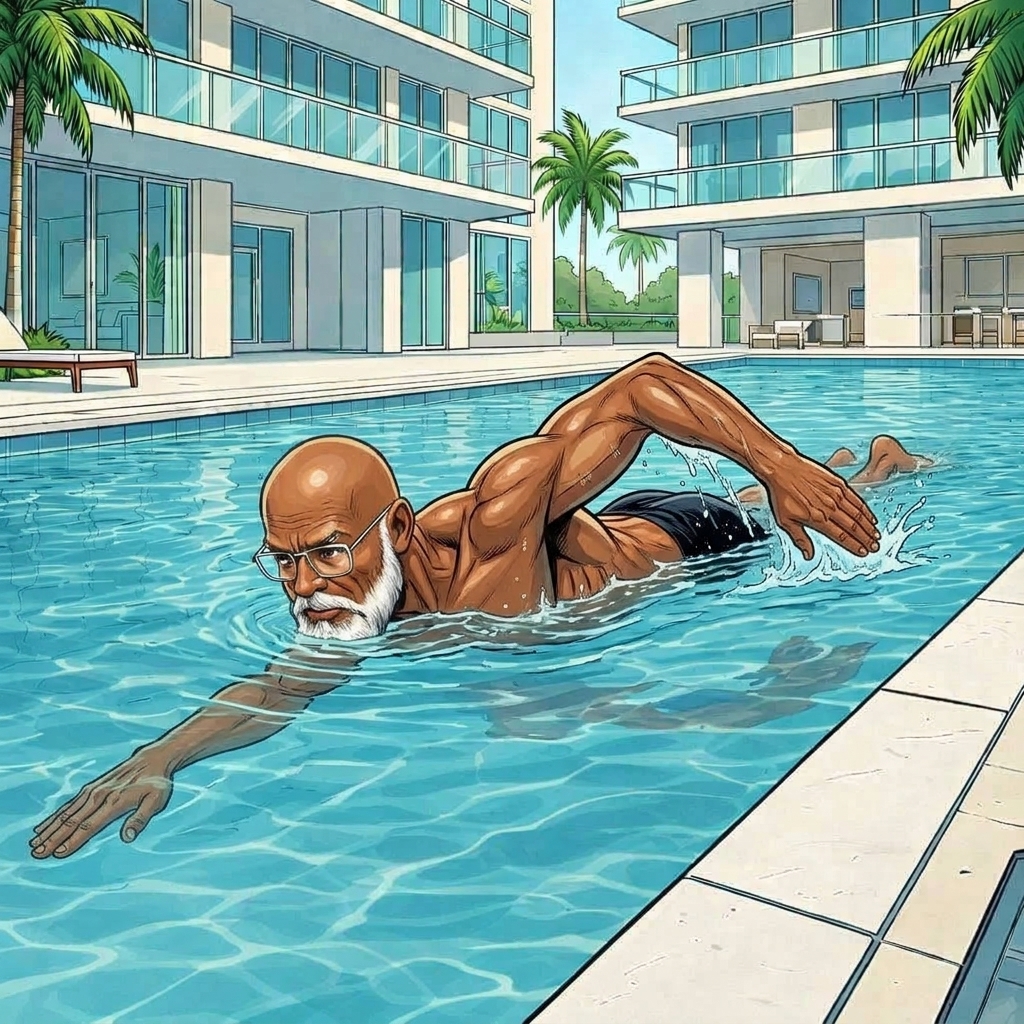
Swimming is the ultimate low-impact option. Full-body work. Zero spinal compression. If your knees, hips, or back complain during other cardio, this is your answer.
Execution: Twenty to thirty minutes of continuous laps at a sustainable pace. Mix strokes if you want. Breaststroke and freestyle cover most of what you need.
Coaching Tip: Don’t sprint laps. That’s not the point here. Steady effort. Breathe every two or three strokes. If you’re gasping at the wall every length, you’re going too hard.
Option 4: Light Sprint Sets (20–40 Yards)
This is the spicy option. Short sprints build power and spike your heart rate fast. But “sprint” here means fast and controlled, not all-out competition speed. Research on interval training shows that short efforts with full recovery produce cardiovascular adaptations that steady-state work struggles to match .
Execution: Mark out 20 to 40 yards. Sprint at about 70–80 percent effort. Walk back slowly. That’s one rep. Rest 30–60 seconds. Do six to eight reps total. Done in fifteen minutes.
Coaching Tip: The walk back is not optional. Full recovery between reps is what makes short sprints work. Cut the rest and you turn a power workout into sloppy conditioning. Also: warm up first. Cold sprints are how hamstrings get angry. A few minutes of walking and leg swings before you go.
How to choose: If your joints ache, swim. If you want something mindless, walk. If you want to feel athletic, sprint. If you hate all of them, cycle while watching television. The modality matters less than the consistency. Twice per week. That’s the target.
How to Put It Together
Alternate one strength exercise with one conditioning exercise. Rest thirty to sixty seconds between movements. Three rounds. Done in twenty-five minutes.
Do this three times per week. Not four. Not five. Three. Your connective tissue adapts slower than your muscles. Tendons and ligaments need time to catch up. That’s the part that sidelines eager beginners who go from zero to daily burpees in a weekend.
Mobility Work That Actually Matters
The World’s Greatest Stretch
This exercise earns its name. It hits your hips, thoracic spine, and shoulders in one movement. Use it as part of your warm-up. Dynamic movement before training. Static stretching after.
Execution: Step into a long lunge. Place both hands inside your front foot. Rotate your torso and reach the arm closest to your front foot toward the ceiling. Return. Step back to plank. Switch sides. Five reps per side.
Coaching Tip: Keep your hips square. Don’t let your front knee collapse inward. If you can’t reach the floor, put your hands on a yoga block or a stack of books.
Important Point: Explanation
Hybrid training works because it develops multiple fitness qualities without requiring you to live in the gym.
Strength without conditioning leaves you gassed on the stairs. Conditioning without strength leaves you fragile. But the blend only works if you can recover from it. That’s the piece most beginner programs ignore. You’re not training for a competition. You’re training for the next thirty years of your life.
Three solid sessions per week beats five sloppy ones every single time. And the floor press will save your shoulders while the kettlebell swing teaches your hips to do their job. That combination, done consistently, will change how you move.