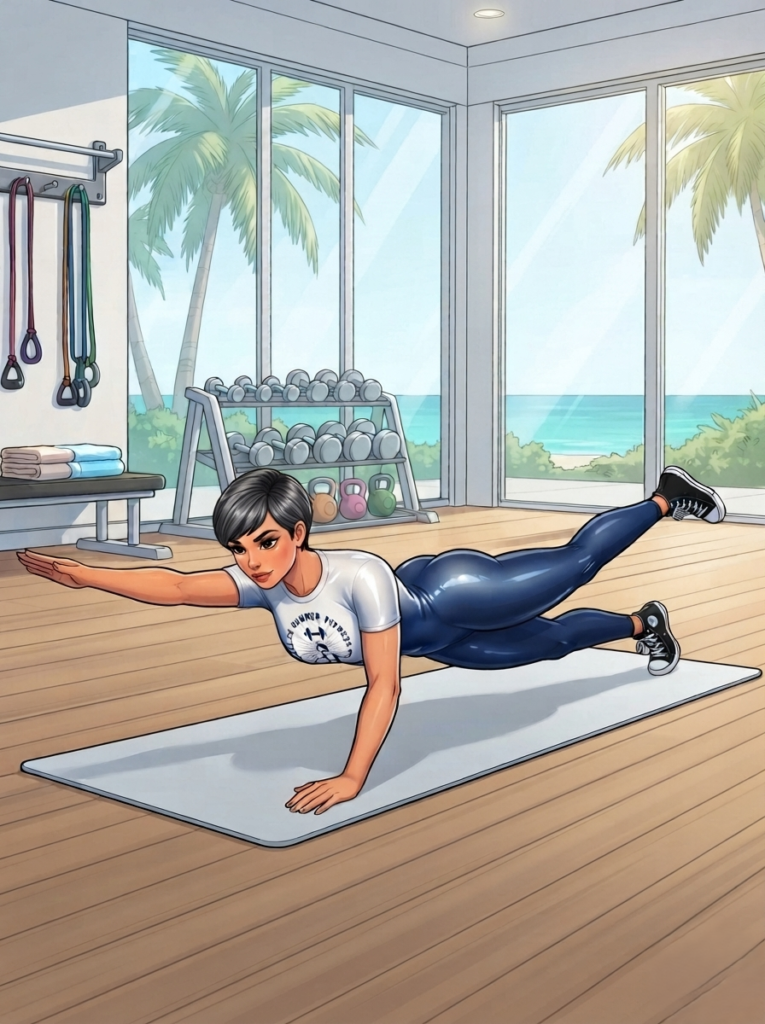
Strengthening the posterior chain remains critical for postural endurance, spinal health, and injury prevention. The prone swimmer exercise—often called the prone flutter or swimmer extension—targets the glutes, hamstrings, upper back, and deep spinal erectors.
Cranking the limbs as high as possible into extreme hyperextension crushes the facet joints of the lower back. Executed correctly, the swimmer exercise builds dynamic posterior chain endurance while keeping the lumbar spine in a safe, neutral range.
Biomechanical Mechanics and Joint Safety
Prone extension movements require strict motor control to prevent excessive lumbar shear. Lifting legs or arms too high forces the lumbar vertebrae into end-range hyperextension, compressing nerve pathways and irritating joint cartilage.
Apply these rules to execute prone swimmer movements safely:
- Maintain Neutral Range: Lift limbs only 2 to 3 inches off the floor. Focus on lengthening the spine from head to toe rather than seeking vertical height.
- Brace the Abdominal Wall: Contract your glutes and press your pubic bone lightly into the floor before lifting a single limb. This creates anterior core tension, locking the lumbar spine in a safe, neutral position.
- Dynamic Warm-Up First: Perform 5 minutes of low-load movement—such as quadruped cat-camels, thoracic rotations, and glute bridges—to prepare the spinal erectors and hip extensors. Save static hamstring and pectoral stretching for post-workout cool-downs.
Targeted Anatomy
The prone swimmer exercise recruits multiple muscle groups to maintain spinal alignment and hip extension:
- Erector Spinae & Multifidus: Maintain isometric extension along the vertebral column without allowing hyper-arching.
- Gluteus Maximus & Hamstrings: Drive primary hip extension to lift the legs off the floor in a controlled arc.
- Latissimus Dorsi & Posterior Deltoids: Control shoulder extension and stabilize the scapulae as the arms lift and reach.
- Transverse Abdominis & Obliques: Provide anterior anti-extension stabilization, protecting the lumbar spine from compressive forces.
Step-by-Step Execution Guide
Prone Swimmer Protocol
Setup Position
Lie face down on an exercise mat. Extend your arms overhead with palms facing down and legs straight behind you, feet hip-width apart. Rest your forehead gently on the mat to maintain a neutral neck.
Core Initialization
Contract your glutes hard and press your pubic bone into the mat. Draw your abdominal wall slightly inward while maintaining 360-degree core pressure to stabilize your pelvis.
Alternating Limb Extension
Simultaneously lift your right arm and left leg 2 to 3 inches off the floor. Reach forward through your fingertips and backward through your toes to create length through the torso. Hold for 1 second at the top.
Controlled Transition
Lower your right arm and left leg under strict control until touching the mat. Immediately repeat the movement with your left arm and right leg.
Prescription: Perform 10 to 12 controlled reps per side for 2 to 3 sets. Rest 60 seconds between sets.
3 Critical Form Cues
- Keep Your Gaze Down: Look at the mat throughout the entire set. Cranking your head upward hyperextends the cervical spine and places unnecessary stress on the neck muscles.
- Do Not Twist the Pelvis: Keep both hip bones firmly grounded against the mat. Rotating the hips to gain height twists the lumbar spine under load.
- Control the Tempo: Avoid fast, jerky flutter kicks. Use a controlled 1-second lift, 1-second hold, and 1-second lowering tempo to maximize motor unit recruitment.
Programming Integration
Incorporate prone swimmers into your warm-up sequence or pair them with anti-rotational core exercises like the Pallof press during accessory training. Limit volume to 2 to 3 non-consecutive days per week to allow muscular recovery across the spinal erectors.
References
- McGill, S. M. (2002). Low Back Disorders: Evidence-Based Prevention and Rehabilitation. Human Kinetics.
- Aasa, B., et al. (2015). Individualized low-load motor control exercises and high-load resistance exercises for patients with low-back pain. British Journal of Sports Medicine, 49(16), 1054–1060.
- Schoenfeld, B. J. (2010). The mechanisms of muscle hypertrophy and their application to resistance training. Journal of Strength and Conditioning Research, 24(10), 2857–2872.