
Building sustainable physical capacity requires daily movement, but loaded resistance training and high-impact exercises need dedicated recovery time. Connective tissues, joints, and muscular systems adapt during rest, not during the workout itself. Here are 10 Daily Bodyweight Exercises.
Your next step to fitness success: Low-Impact Cardio Over 40: 5 Exercises You Will Enjoy
The following routine distinguishes between daily foundational movement (light cardio and dynamic mobility) and targeted strength exercises that should be performed 3–4 days per week with adequate rest between sessions.
The 10 Essential Movements
1. Daily Brisk Walking
Walking provides low-impact cardiovascular conditioning, aids venous return, and promotes joint lubrication without taxing the central nervous system.
- Volume: 30–45 minutes total per day (can be split into 10–15 minute bouts).
- Execution: Maintain an upright posture, drive lightly through the heel, and allow a natural arm swing.
2. Bodyweight Squats
Squats strengthen the quadriceps, glutes, and hip extensors while reinforcing foundational movement patterns.
- Frequency: 3–4 days per week (not daily).
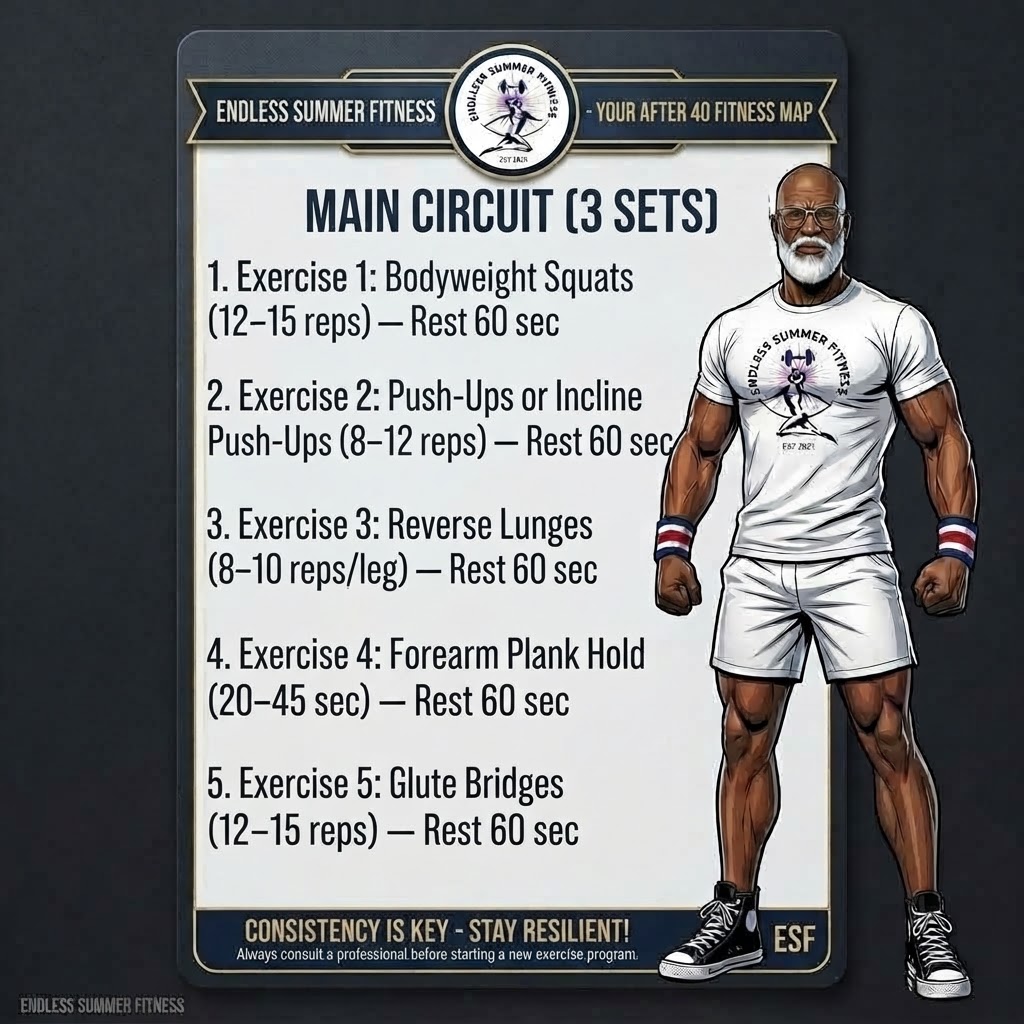
- Volume: 3 sets of 12–15 repetitions.
- Execution: Set feet hip-to-shoulder-width apart. Initiate the movement by hinging at the hips and sitting back. Lower until thighs are parallel to the floor, keeping heels grounded and chest upright. Push through the mid-foot and heel to return to standing.
3. Incline or Standard Push-Ups
Push-ups develop horizontal pushing strength across the pectorals, anterior deltoids, triceps, and core stabilizers.
- Frequency: 3–4 days per week.
- Volume: 3 sets of 8–12 repetitions.
- Execution: Place hands shoulder-width apart. Maintain a neutral spine from head to heels. Lower your chest toward the floor with elbows tracking back at a 45-degree angle relative to your torso. Modify by placing hands on an elevated surface (bench or wall) to maintain proper spinal alignment.
4. Forearm Plank Holds
The forearm plank trains isometric core stability, teaching anti-extension to protect the lumbar spine.
- Frequency: 3–4 days per week.
- Volume: 3 sets of 20–45 second holds.
- Execution: Place forearms on the floor with elbows directly under shoulders. Engage glutes and brace the abdomen. Prevent the hips from sagging or rising, maintaining a straight line from ears to ankles.
5. Reverse Lunges
Reverse lunges build unilateral leg strength and single-leg stability while placing less shear force on the patellar tendon than forward lunges.
- Frequency: 3–4 days per week.
- Volume: 3 sets of 8–10 repetitions per leg.
- Execution: Stand upright, step backward with one leg, and lower the back knee toward the floor until both knees reach approximately 90-degree angles. Drive through the front heel to return to the starting position.
6. Bird-Dog (Spinal-Sparing Core Stability)
Replacing high-rotation sit-ups, the Bird-Dog strengthens the posterior chain and core while preserving intervertebral disc integrity.
- Frequency: Daily or 4–5 days per week.
- Volume: 3 sets of 8–10 controlled repetitions per side.
- Execution: Begin on hands and knees. Simultaneously extend the right arm forward and left leg backward until both are parallel to the floor. Hold for 2 seconds at full extension, return to center under control, and alternate sides. Keep hips and shoulders square throughout.
7. Low-Impact Step Jacks
Step jacks provide dynamic shoulder elevation and heart rate response without the joint impact of high-impact jumping.
- Frequency: Daily (as warm-up) or 3–4 days per week.
- Volume: 3 sets of 30–45 seconds.
- Execution: Step one foot out to the side while raising both arms overhead. Step back to center and repeat on the opposite side at a steady, rhythmical pace.
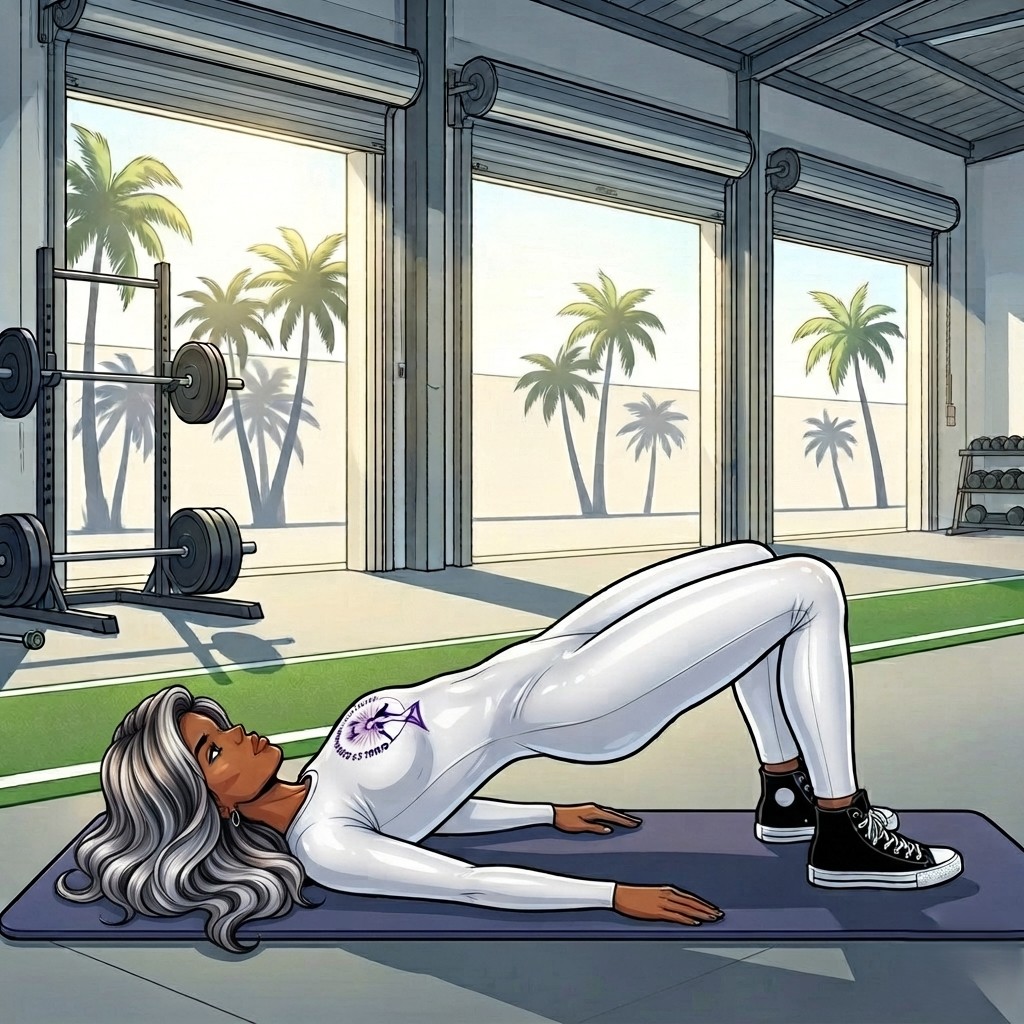
8. Glute Bridges
Glute bridges activate the gluteus maximus and hamstrings while teaching proper hip extension without over-extending the lower back.
- Frequency: 3–4 days per week.
- Volume: 3 sets of 12–15 repetitions.
- Execution: Lie flat on your back with knees bent and feet flat on the floor, hip-width apart. Drive through your heels to lift hips until thighs and torso align. Squeeze glutes at the top for 1–2 seconds, then lower under control. Avoid arching the lumbar spine.
9. Unweighted Arm Circles & Shoulder Rolls
An unweighted dynamic mobility drill to improve rotator cuff blood flow and shoulder girdle range of motion.
- Frequency: Daily (ideal during warm-ups).
- Volume: 2–3 sets of 10–15 small, controlled circles forward and backward.
- Execution: Stand tall with arms extended to the sides at shoulder height. Perform small, smooth circles without using external weights. Focus on controlled shoulder blade movement.
10. Post-Workout Static Stretching
Static stretching relaxes hypertonic muscles and aids flexibility when performed on warm tissue after exercise.
- Frequency: Daily or following workout sessions.
- Volume: Hold each stretch for 20–30 seconds without bouncing.
- Execution: Focus on major muscle groups (hamstrings, hip flexors, chest, calves). Breathe deeply and move only to the point of mild tension, never sharp pain.
Daily Schedule Structure
Morning Mobility & Walking Routine (Daily)
- Dynamic Warm-Up (3–5 minutes): Arm circles, leg swings, and gentle torso turns to increase blood flow.
- Brisk Walk (20–30 minutes): Maintain a steady pace that allows conversation.
- Post-Walk Cool-Down (3–5 minutes): Light calf, quadricep, and hamstring static stretches.
Structured Calisthenics Routine (3–4 Days Per Week)
Allow 24–48 hours of recovery between structured strength sessions to promote connective tissue remodeling.
Warm-Up (5 Minutes)
- 2 minutes light low-impact step jacks or marching in place.
- 1 set of 10 Unweighted Arm Circles (forward/backward).
- 1 set of 8 Bird-Dogs per side.
Cool-Down (5 Minutes)
Perform static stretches targeting the chest, hip flexors, lower back, and hamstrings. Hold each position for 20–30 seconds.
Key Execution Rules
- Prioritize Dynamic Movement Before Workouts: Never static-stretch cold muscles prior to exercise. Use dynamic mobility to prepare joints and elevate tissue temperature.
- Avoid Daily High-Volume Loading: Muscular adaptations require structural recovery. Keep resistance exercises to alternating days.
- Respect Joint Limits: Exercise should create metabolic fatigue and muscular tension, not joint pain. Modify ranges of motion if discomfort occurs.
Medical Disclaimer: This article is for educational and informational purposes only and does not constitute medical advice. Always consult a physician or qualified health professional before beginning any new exercise program, particularly if you have pre-existing medical conditions or joint concerns.
Here are the authoritative scientific sources supporting the exercise physiology, biomechanics, and recovery principles outlined in the article:
References & Scientific Sources
-
American College of Sports Medicine (ACSM)
Guideline: Quantity and Quality of Exercise for Developing and Maintaining Cardiorespiratory, Musculoskeletal, and Neuromotor Fitness in Apparently Healthy Adults.
Key Takeaway: Validates the recommended 30–45 minutes of daily walking and outlines guidelines for resistance training 2–3 days per week to allow adequate muscular recovery.
Link: ACSM Physical Activity Guidelines -
National Institutes of Health (NIH) / PubMed Central
Study: The Science and Physiology of Flexibility and Stretching (Behm et al.)
Key Takeaway: Demonstrates that pre-workout static stretching cold muscles can transiently decrease peak force production, confirming that dynamic warm-ups should precede workouts while static stretching is best reserved for post-workout cool-downs.
Link: NIH – Stretching and Injury Prevention Research -
National Strength and Conditioning Association (NSCA)
Guideline: Principles of Exercise Prescription and Tendon/Connective Tissue Adaptation.
Key Takeaway: Highlights that connective tissue synthesis and tendon collagen remodeling require 24–48 hours of recovery between resistance sessions to prevent overuse tendinopathies.
Link: NSCA Resource Library -
Journal of Biomechanics & Spine Research
Study: Low Back Disorders: Evidence-Based Prevention and Rehabilitation (McGill, S.)
Key Takeaway: Supports the replacement of high-shear/rotational lumbar movements (like sit-ups or repetitive crunches) with spinal-sparing core stabilization exercises such as the Bird-Dog and Forearm Plank.
Link: PubMed – Biomechanics of Lumbar Spine Stabilization