

Lower back stiffness and lumbar discomfort can disrupt daily movement, but restoring stability does not require complex gym equipment or hours of training. A focused, 15-minute daily routine can strengthen the deep core stabilizers, glutes, and lumbar support structures, helping relieve tension and support long-term spinal health.
If you are looking to build a well-rounded foundation for functional health and overall movement, explore our Hybrid Fitness Training: The Complete Beginner’s Guide for structured, low-impact exercise strategies tailored to your lifestyle.
Understanding how your lower back works with the rest of your body is the first step toward lasting relief. The lumbar spine relies on a complex network of muscles, tendons, and ligaments to keep you upright and mobile. When key supporting groups like the glutes or deep abdominals become weak or inactive, the lower back takes on extra strain to compensate. Over time, this extra load causes muscle fatigue, stiffness, and ongoing discomfort.
By performing post-physical therapy exercises consistently, you re-educate these core support systems to handle daily stress. This routine focuses on building endurance in the muscles that stabilize your spine, improving joint mobility, and helping you move with confidence during everyday tasks.
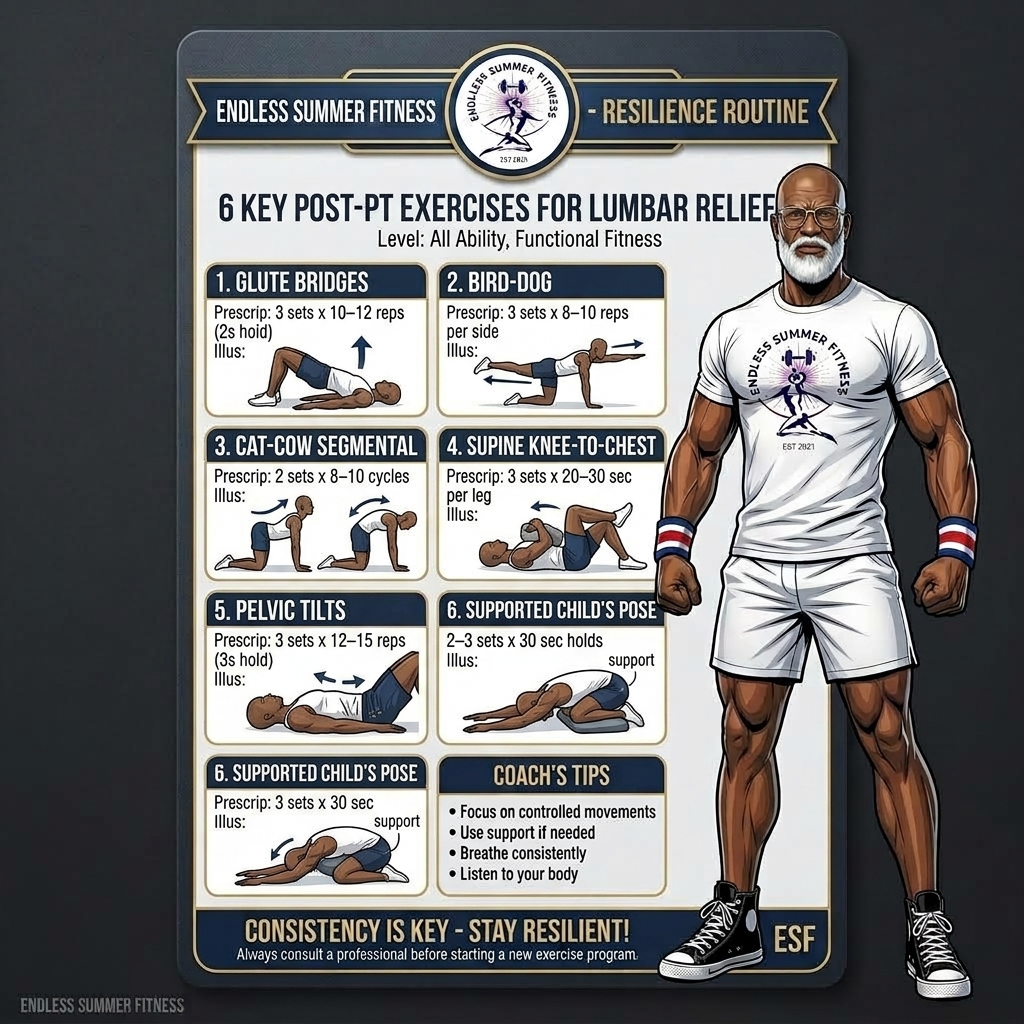
1. Glute Bridges
- Prescription: 3 sets × 10–12 controlled repetitions (2-second hold at the top)
- Execution: Lie flat on your back with knees bent, feet flat on the floor, and hips distance apart. Engage your deep abdominal wall and press through your heels to lift your hips until your shoulders, hips, and knees form a straight line. Lower back down with control.
- Biomechanical Benefit: Bridges target the gluteus maximus and hamstrings. By establishing proper hip extension, this exercise relieves unnecessary strain on the lumbar extensors and helps balance muscle activity across the lower body.
2. The Bird-Dog
- Prescription: 3 sets × 8–10 repetitions per side (controlled tempo)
- Execution: Begin in a quadruped position on hands and knees, with wrists aligned under shoulders and knees directly under hips. Keeping your core braced and hips square to the floor, simultaneously extend your right arm forward and left leg straight back. Pause briefly, return to the starting position, and alternate sides.
- Biomechanical Benefit: This cross-body movement strengthens the multifidus and erector spinae muscles. It trains anti-rotational core stability, protecting your spine from twisting forces without placing heavy compressive loads on the lower back.
3. Cat-Cow Segmental Stretch
- Prescription: 2 sets × 8–10 slow, breath-synchronized cycles
- Execution: From a quadruped position, inhale as you gently drop your belly toward the floor, tilt your pelvis forward, and lift your chest into extension (Cow). On the exhale, slowly press through your hands, round your spine toward the ceiling, and tuck your chin toward your chest (Cat).
- Biomechanical Benefit: This fluid movement mobilizes individual thoracic and lumbar segments. It helps distribute fluid within intervertebral discs and eases tight muscles along the length of your spine.
4. Supine Knee-to-Chest Stretch
- Prescription: 3 sets × 20–30 second holds per leg
- Execution: Lie flat on your back. Keep one leg extended or bent flat on the floor while drawing the opposite knee gently toward your chest with both hands. Maintain relaxed breathing and avoid lifting your lower back aggressively off the floor.
- Biomechanical Benefit: Gently lengthens tight lower back muscles and gluteal fibers. This simple position reduces localized tension around the sacroiliac joint and helps calm sensitive spinal nerves.
5. Pelvic Tilts
- Prescription: 3 sets × 12–15 repetitions (3-second isometric hold)
- Execution: Lie on your back with knees bent and feet flat. Contract your lower abdominal muscles to tilt your pelvis posteriorly, flattening your lower back completely against the floor. Hold the contraction briefly before releasing to a neutral spine.
- Biomechanical Benefit: Activates the transverse abdominis and internal obliques. Practicing pelvic control builds foundational anterior stability, which helps maintain a natural, painless spinal alignment throughout the day.
6. Supported Child’s Pose
- Prescription: 2–3 sets × 30-second passive holds
- Execution: Kneel on the floor, bring your big toes together, and widen your knees slightly. Sit your hips back toward your heels as you walk your hands forward on the floor, lowering your chest toward the ground. Focus on deep diaphragmatic breathing into your lower back.
- Biomechanical Benefit: Provides gentle traction for the lumbar vertebrae and decompresses spinal joints. It offers a passive stretch for the lower back and lats while giving your nervous system a chance to relax.
Guidelines for Safe Execution and Long-Term Results
To get the most out of these post-physical therapy movements, pay close attention to how you perform each repetition. Speed and intensity are far less important than clean control and body awareness.
- Focus on Quality Control: Perform every movement with clear intention rather than rushing through your sets. Smooth, steady motion builds better muscular habits and protects sensitive joints.
- Stay in a Pain-Free Zone: You should feel your muscles working and a comfortable stretch, but you should never push through sharp, shooting, or radiating pain. If an exercise hurts, back off or skip it for the day.
- Breathe Naturally: Avoid holding your breath during exertion. Exhale through the hardest part of each movement, and focus on slow, deep belly breathing during your static stretches.
- Build Daily Consistency: Short, frequent sessions yield far better outcomes than occasional longer workouts. Spending 15 minutes every day helps keep your joints mobile and your stabilizing muscles firing correctly.
References
-
Core Stability Exercises in Low Back Pain Management (PubMed / NIH)
- Focus: Demonstrates the efficacy of targeted core stabilization, glute activation, and low-impact exercise programs in reducing chronic low back discomfort and restoring physical capacity.
-
Exercise Therapy for Chronic Low Back Pain (PMC / NIH)
- Focus: Clinical review highlighting how structured therapeutic movement, pelvic control, and progressive mobility protocols support spinal integrity and long-term functional mobility.
Medical Disclaimer: This article is for educational and informational purposes only and does not constitute medical advice. Always consult a physical therapist, physician, or certified fitness professional before beginning a new recovery or exercise program, especially if you have pre-existing spinal conditions.