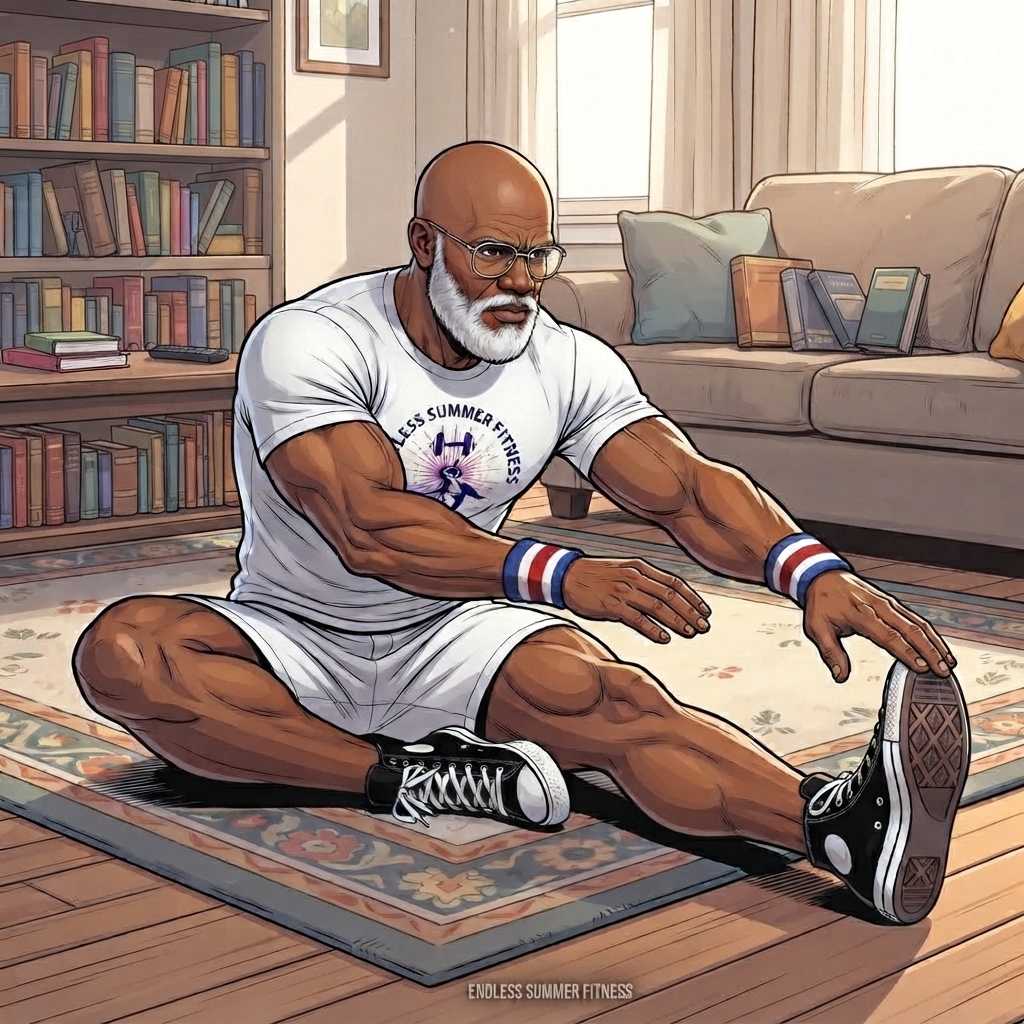
Maintaining joint flexibility and soft-tissue elasticity is vital for daily movement, posture, and spinal health. As we age, tendons and joint capsules lose natural hydration, leading to stiffness in the hips, shoulders, and lower back. This is why as we age, we all need safe stretches for range of motion & relief and mobility
However, aggressive stretching—such as forcing deep lower-back bends or pulling joints to their absolute limit—can cause micro-tears in connective tissue or put compressive force on lumbar discs.
The key to long-term mobility is gentle, active positioning combined with steady diaphragmatic breathing. By working within a comfortable, pain-free range of motion, you signal your nervous system to release muscle tension safely.
Below are 21 joint-sparing stretches organized into a complete weekly routine. Perform each movement smoothly without bouncing or forcing the joint.
Guidelines for Safe Stretching
- Breathe Deliberately: Inhale slowly through your nose and exhale fully through your mouth during every stretch. Deep breathing lowers nervous system tension, allowing muscles to relax naturally.
- Avoid End-Range Compression: Never force a joint into severe hyperextension or painful twisting. Stop as soon as you feel a mild, comfortable lengthen in the targeted muscle.
- Maintain Spinal Alignment: Keep your spine neutral during leg and hip stretches by hinging from the hips rather than rounding your lower back.
7-Day Targeted Mobility Routine
Perform the designated stretches daily. Hold static positions for 20 to 30 seconds and repeat each 2 to 3 times.
Day 1: Neck & Upper Shoulder Mobility
1. Seated Ear-to-Shoulder Release
- How to do it: Sit upright in a chair with shoulders relaxed. Slowly tilt your right ear toward your right shoulder without lifting the shoulder. Hold for 20 seconds while breathing deeply, then return to center and repeat on the left side.
2. Gentle Chin Tuck & Extension
- How to do it: Sit tall and slowly draw your chin straight back, as if making a slight double chin, to lengthen the back of your neck. Hold for 2 seconds, release, and gently nod your head slightly upward without throwing your head backward. Perform 10 controlled reps.
3. Scapular Shoulder Rolls
- How to do it: Stand or sit upright. Roll your shoulders upward, backward, and down in a broad, smooth circular motion for 30 seconds. Reverse the direction for another 30 seconds.
Day 2: Chest & Mid-Back Extension
4. Doorway Chest Opener
- How to do it: Stand in an open doorway. Place your forearms flat against the doorframe with your elbows bent at 90 degrees at chest height. Take a small step forward with one foot until you feel a gentle stretch across your chest and front shoulders. Hold for 30 seconds.
5. Supported Quadruped Thread-the-Needle
- How to do it: Start on your hands and knees on a cushioned mat. Slide your right arm along the floor under your left arm, resting your right shoulder and cheek gently on the mat. Hold for 20 seconds to open the upper back, then switch sides.
6. Supported Child’s Pose
- How to do it: Kneel on the floor, widen your knees slightly, sit your hips back toward your heels, and reach your arms straight forward along the floor. Let your chest sink toward the mat while taking slow, deep breaths. Hold for 60 seconds.
Day 3: Hip & Glute Relievers
7. Half-Kneeling Hip Flexor Stretch
- How to do it: Kneel on a padded mat with your right knee on the floor and left foot flat in front, knee at 90 degrees. Gently tuck your tailbone under and shift your hips forward an inch until you feel a light stretch in the front of your right hip. Hold for 30 seconds per side.
8. Supine Figure-Four Stretch
- How to do it: Lie flat on your back with knees bent and feet flat on the floor. Cross your right ankle over your left knee. Clasp your hands behind your left thigh and gently draw it toward your chest until you feel a stretch in your right glute. Hold for 30 seconds per side.
9. Seated Glute & Outer Hip Opener
- How to do it: Sit tall on the edge of a sturdy chair. Cross your right ankle over your left knee. Keeping your spine straight, hinge forward slightly at the hips until you feel a clean stretch in the outer hip. Hold for 30 seconds, then switch.
Day 4: Hamstring & Calf Length
10. Supported Standing Hamstring Hinge
- How to do it: Stand facing a low step or sturdy block. Place your right heel on the step with your toes pointing up and knee slightly soft. Keeping your back flat, hinge at your hips until you feel a comfortable lengthen behind your right thigh. Hold for 30 seconds per side.
11. Wall-Supported Calf Stretch
- How to do it: Stand facing a wall at arm’s length. Step your right leg straight back, pressing the right heel flat into the floor while bending your front knee. Keep your back leg straight and hips square. Hold for 30 seconds, then switch legs.
12. Supine Towel Hamstring Stretch
- How to do it: Lie on your back on a mat. Loop a soft strap or towel around the arch of your right foot. Extend your right leg toward the ceiling with a slight bend in the knee, gently pulling the strap until you feel a mild stretch. Hold for 30 seconds per leg.
Day 5: Low-Back & Trunk Stability
13. Gentle Quadruped Cat-Cow
- How to do it: Position yourself on all fours with hands under shoulders and knees under hips. Inhale as you gently tilt your pelvis forward to let your belly sink slightly. Exhale as you softly round your upper back toward the ceiling. Move smoothly between positions for 60 seconds without forcing range.
14. Supine Single-Knee-to-Chest
- How to do it: Lie flat on your back with both legs extended. Draw your right knee up toward your chest, clasping your hands gently below the kneecap. Keep your neck and shoulders flat on the mat. Hold for 30 seconds, then alternate legs.
15. Supported Lumbar Side-Lying Twist
- How to do it: Lie on your right side with knees stacked and bent at 90 degrees. Extend both arms straight out in front of you. Keeping your hips still, slowly open your left arm toward the left floor, turning your upper torso gently. Hold for 20 seconds per side.
Day 6: Full-Body Functional Mobility
16. Overhead Side Angle Stretch
- How to do it: Stand with feet hip-width apart. Raise your right arm overhead and gently lean your upper body to the left, keeping your weight evenly distributed across both feet. Hold for 20 seconds, then repeat on the opposite side.
17. Standing Hip Circles
- How to do it: Stand tall with hands on your hips (or holding a sturdy chair for balance). Perform slow, controlled circular rotations with your hips to mobilize the pelvis and hip sockets. Do 10 circles clockwise and 10 counter-clockwise.
18. Wide-Stance Adductor Shift
- How to do it: Stand with feet wider than shoulder-width apart, toes pointing forward. Slowly shift your body weight to the right by bending your right knee slightly while keeping the left leg straight. Hold for 20 seconds to stretch the inner thigh, then switch.
Day 7: Active Decompression & Rest
19. Legs-Up-The-Wall Pose
- How to do it: Sit close to a wall, roll onto your back, and extend your legs straight up against the wall so your body forms a 90-degree angle. Rest your arms at your sides, close your eyes, and focus on slow abdominal breathing for 3 to 5 minutes.
20. Supine Butterfly Stretch
- How to do it: Lie flat on your back on a padded mat. Bring the soles of your feet together and let your knees drop open softly to the sides. Place a pillow under each thigh for joint support if needed. Hold for 2 minutes while breathing deeply.
21. Complete Body Decompression Hold
- How to do it: Lie completely flat on your back with arms extended straight overhead along the floor and legs straight out. Inhale deeply while reaching through your fingertips and toes for 5 seconds, then exhale completely and let your whole body relax flat into the floor. Repeat 5 times.
Guidelines for Consistent Progress
- Never Stretch to Pain: Discomfort is a warning sign. A stretch should feel like a mild, releasing tension—never a sharp or burning sensation.
- Stay Consistent Over Time: Short, 5-to-10-minute daily mobility sessions yield far better results than one long, aggressive stretch once a week.
- Combine Mobility with Hydration: Connective tissue relies on adequate hydration to stay pliable and move smoothly across muscle fibers.
Summary
Improving flexibility does not require aggressive contortions or risking joint strain. By following a structured daily approach that targets specific muscle groups with controlled, supported positions, you can ease stiffness, improve posture, and maintain joint health safely over time.
Peer-Reviewed References & Standards
-
American College of Sports Medicine (ACSM)
Guideline: Flexibility & Mobility Recommendations for Health and Fitness.
Takeaway: Recommends performing static flexibility exercises 2 to 3 times per week, holding each stretch for 10 to 30 seconds to safely improve joint range of motion.
Link: ACSM Physical Activity Guidelines -
National Strength and Conditioning Association (NSCA)
Guideline: Principles of Flexibility, Stretching, and Joint Integrity.
Takeaway: Recommends supported static stretching and active mobility drills over end-range dynamic bouncing to protect joint capsules and spinal structures.
Link: NSCA Education & Research -
International Journal of Sports Physical Therapy
Study: The Impact of Static Stretching on Connective Tissue and Joint Mobility
Takeaway: Demonstrates that low-intensity static stretching combined with slow respiration effectively reduces muscle-tendon stiffness without triggering protective muscle spasms.
Link: PubMed Central Research
Medical Disclaimer: This article is for educational and informational purposes only and does not constitute medical advice. Always consult a physician or physical therapist before starting a new exercise or stretching routine.