High-volume resistance band workouts for joint strength means tension increases as the band stretches, reaching peak resistance at full muscular contraction. This unique kinetic curve matches the natural strength curve of human joints, minimizing stress on connective tissue during the vulnerable stretched position.
Looking to build a complete joint-friendly routine? 6 Strong Hybrid Movements for 40+ Adults
Whether you are beginning a routine or progressing your physical capacity, utilizing elastic resistance allows you to build muscular endurance, mobility, and functional capacity without subjecting your joints to heavy free-weight compression.
Core Principles for Safe Execution
- The 3-Second Eccentric Rule: Return from every contraction over a full 3-second count. Controlling the return phase eliminates slack in the band and builds tendon resiliency.
- Constant Band Tension: Never allow the band to go slack at the bottom of a repetition. Maintain continuous tension throughout the entire range of motion.
- Pain-Free Range of Motion: Move smoothly through a complete, comfortable range of motion. Never force a joint past its natural structural limit.
1. Beginner Resistance Band Routine
Perform 3 sets of each exercise. Rest 45 to 60 seconds between sets.
Dynamic Warm-Up (5 Minutes)
- Arm Circles: 60 seconds (smooth, controlled rotations)
- Standing Leg Swings: 60 seconds per leg (front-to-back, gentle range)
- Low-Impact Marching in Place: 2 minutes (drive knees to hip height)
Beginner Workout Exercises
1. Band-Resisted Chair / Box Squat
- Volume: 3 sets of 12–15 repetitions
- Tempo: 3-second lowering phase, 1-second touch pause, 1-second stand
- Execution: Stand on the middle of a loop or tube band with feet shoulder-width apart, holding the handles at shoulder height. Hinge at the hips and sit back slowly over 3 seconds until your glutes touch a sturdy chair. Drive through your mid-foot to stand up without locking out your knees.
2. Anchor-Supported Band Chest Press
- Volume: 3 sets of 12–15 repetitions
- Tempo: 1-second press, 3-second controlled return
- Execution: Anchor the band behind you at chest height. Stand in a staggered stance for balance, holding handles at chest level. Press forward until arms extend smoothly without locking elbows, then control the return phase over a full 3-second count.
3. Seated Band Row
- Volume: 3 sets of 12–15 repetitions
- Tempo: 1-second pull, 1-second scapular squeeze, 3-second return
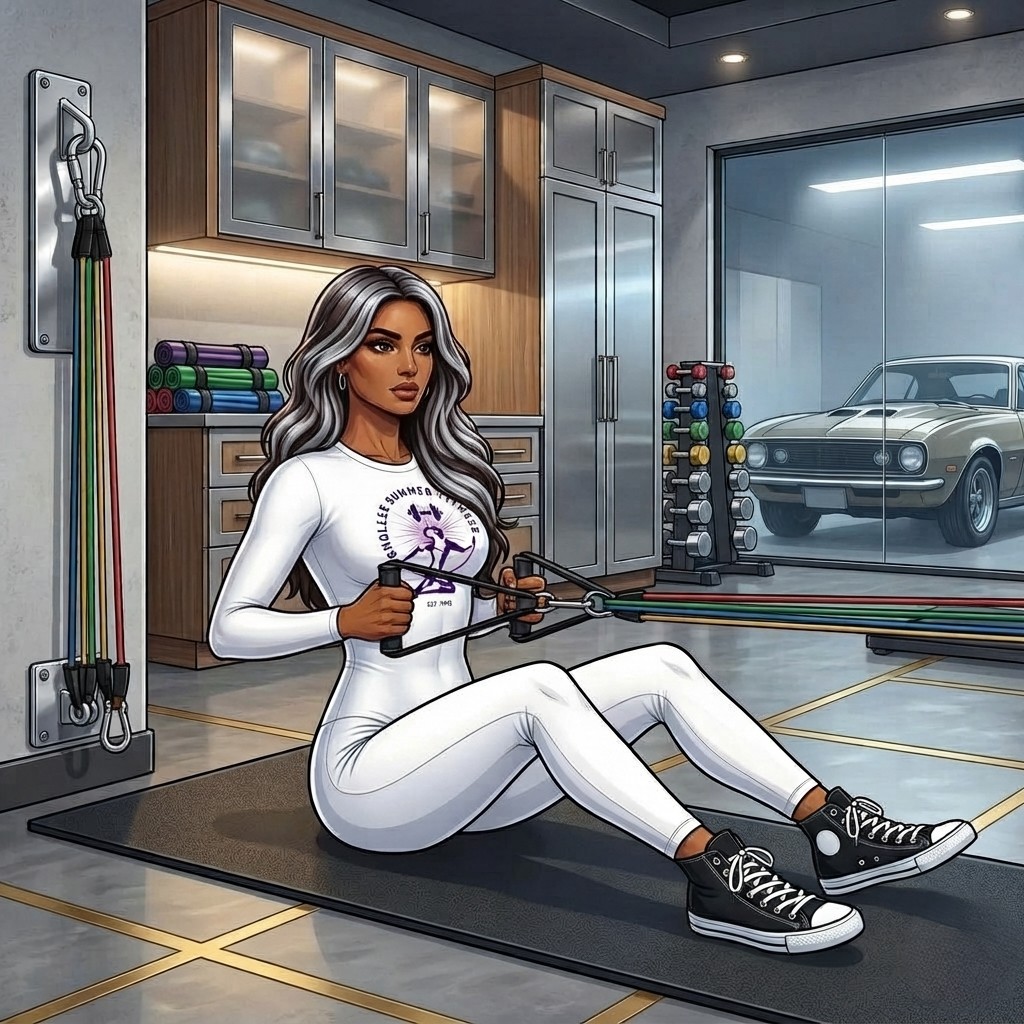
- Execution: Sit on a mat with legs extended straight. Loop the band around the mid-foot of both shoes. Hold the handles, sit tall with a flat back, and pull your elbows back close to your ribs, squeezing your shoulder blades together. Slowly return over 3 seconds.
4. Standing Band Biceps Curl
- Volume: 3 sets of 12–15 repetitions
- Tempo: 1-second curl, 3-second lowering
- Execution: Stand on the band with feet hip-width apart. Hold handles with palms facing forward and elbows pinned to your sides. Curl the hands toward your shoulders, squeeze the biceps at the top, and lower under strict 3-second control.
5. Lateral Band Walks
- Volume: 3 sets of 10 steps each direction
- Tempo: Controlled 2-second lateral step
- Execution: Place a mini-loop band around your legs directly above the knees. Assume a quarter-squat stance. Step laterally to the right while keeping constant tension on the band, then follow with the left leg. Complete all steps in one direction before reversing.
6. Band Overhead Triceps Extension
- Volume: 3 sets of 12–15 repetitions
- Tempo: 1-second extension, 3-second lowering
- Execution: Stand on one end of the band with your back foot. Bring the handle behind your back and overhead, keeping your upper arm vertical next to your ear. Extend your forearm upward until your arm is straight, then lower slowly behind your head over 3 seconds.
7. Banded Glute Bridges
- Volume: 3 sets of 15 repetitions
- Tempo: 1-second drive, 2-second top squeeze, 3-second lowering
- Execution: Lie flat on your back with a mini-band placed around your thighs above the knees. Drive through your heels to raise your hips until aligned with your torso while pushing outward against the band. Hold for 2 seconds at the top, then lower over 3 seconds.
Beginner Cool-Down (5 Minutes)
- Standing Hamstring Stretch: 60 seconds per leg
- Standing Quadriceps Stretch: 60 seconds per leg
- Cross-Body Shoulder Stretch: 60 seconds per arm
2. Advanced High-Volume Resistance Band Routine
Perform 3–4 sets of each exercise. Rest 45 to 60 seconds between sets.
Dynamic Warm-Up (5 Minutes)
- Low-Impact Step Jack: 2 minutes (step side-to-side without jumping impact)
- Dynamic Arm & Leg Swings: 3 minutes (controlled multi-planar mobility)
Advanced Workout Exercises
1. Band Squat-to-Overhead Press
- Volume: 3–4 sets of 12–15 repetitions
- Tempo: 3-second squat, 1-second press
- Execution: Stand on the band with feet shoulder-width apart, holding handles at shoulder height. Lower into a squat over 3 seconds. As you drive back up, press the handles overhead in one continuous, fluid motion. Lower the handles back to your shoulders before starting the next rep.
2. Banded Single-Leg Hip Hinge (Deadlift)
- Volume: 3–4 sets of 12 repetitions per leg
- Tempo: 3-second lowering phase, 1-second drive
- Execution: Stand on the center of the band with your right foot, holding both handles. Soften your right knee and hinge at the hips, extending your left leg straight back behind you while keeping your spine neutral. Drive your hips forward to return to standing.
3. Band-Resisted Incline Push-Up
- Volume: 3–4 sets of 10–12 repetitions
- Tempo: 3-second lowering phase, 1-second press
- Execution: Wrap the band across your upper back and secure the ends under your palms. Place hands on a sturdy elevated surface (bench or counter) in a plank position. Lower your chest under control over 3 seconds against the band resistance, then press back up.
4. Standing Bent-Over Band Row
- Volume: 3–4 sets of 12–15 repetitions
- Tempo: 1-second pull, 1-second squeeze, 3-second return
- Execution: Stand on the band with feet hip-width apart. Hinge forward at the hips to a 45-degree angle with a flat spine and soft knees. Pull the handles toward your hips, driving elbows back, then return under 3-second control.
5. Band Pallof Press (Anti-Rotational Core Stability)
- Volume: 3–4 sets of 12–15 repetitions per side
- Tempo: 2-second hold at full extension, 3-second return
- Execution: Anchor the band at chest height. Stand perpendicular to the anchor point, holding the band with both hands against your sternum. Press the band straight out in front of you without allowing your torso to rotate toward the anchor. Hold for 2 seconds, then return to your chest.
Advanced Cool-Down (5 Minutes)
- Seated Hamstring Stretch: 60 seconds per leg
- Doorway Chest & Anterior Deltoid Stretch: 60 seconds per side
- Child’s Pose Hold: 2 minutes
Mindset Pillars for Sustainable Progress
- Patience: Connective tissue adapts slower than muscular tissue. Allow your joints time to build stamina under high-volume protocols.
- Commitment: Follow the controlled tempos and set counts consistently without skipping recovery windows.
- Discipline: Resist the temptation to rush repetitions. Prioritize form and 3-second tempo control over higher band tension.
- Enjoyment: Physical training should enhance your daily life and energy, leaving you invigorated rather than beat up.
Summary
Resistance bands provide an adaptable, low-impact system for building strength without damaging joint structures. By replacing explosive movements with strict 3-second eccentric tempos, you maximize time-under-tension while protecting your spine, knees, and shoulders. Incorporate these routines 2–3 times weekly to support functional mobility and stamina.
References & Scientific Sources
-
American College of Sports Medicine (ACSM)
Guideline: Elastic Resistance Training for Connective Tissue Health and Joint Longevity.
Key Takeaway: Validates that elastic band resistance provides equivalent muscular activation and strength gains to free weights while reducing peak joint shear forces during movement initiation.
Link: ACSM Physical Activity Guidelines -
National Strength and Conditioning Association (NSCA)
Guideline: Biomechanics of Accommodating Resistance in Exercise Prescription.
Key Takeaway: Demonstrates that resistance bands maintain continuous muscular tension throughout the full range of motion, improving joint stability and rotator cuff health in mature adults.
Link: NSCA Education & Performance Resources -
Journal of Sports Science & Medicine / PubMed Central
Study: Comparison of Muscle Activation Between Elastic Resistance and Free Weights
Key Takeaway: Confirms that enforcing a controlled eccentric tempo with elastic bands maximizes localized muscle fiber recruitment without requiring heavy spinal loading.
Link: PubMed – Elastic Resistance & Muscle Activation Research
Medical Disclaimer: This article is for educational and informational purposes only and does not constitute medical advice. Always consult a physician or certified fitness professional before beginning a new exercise program, especially if you have pre-existing joint conditions.