This beginner mobility routine to reduce stiffness is specifically designed for adults in their 40s, 50s, 60s, and 70s who feel locked up after long desk sessions or restless nights. That morning stiffness isn’t inevitable aging—it’s tissue dehydration and joint compression caused by a sedentary lifestyle. By following this progressive routine each morning, you’ll restore your natural range of motion, improve synovial joint health, and reclaim the freedom of movement your body was built for.
Aging is often unfairly equated with an inevitable loss of freedom. For those in their 40s, 50s, 60s, and 70s, the stiffness felt in the morning or after a long Zoom call isn’t just a sign of the times; it is a sign of tissue dehydration and joint compression.
If you spend hours at a desk, your body physically molds to that seated position. Your hip flexors shorten, your shoulders round forward, and your spine loses its natural ability to rotate. Implementing the following beginner mobility routine every morning to reduce stiffness will help you reclaim your natural range of motion and improve your long-term joint health.
A dedicated beginner mobility routine to reduce stiffness is the most effective way to “un-mold” the body. Unlike high-impact aerobics, mobility work focuses on restoring the lubrication within the joint capsule.
This process, often referred to as synovial joint health, is critical as we age because it ensures that cartilage remains nourished and resilient. For the hybrid athlete over 40, this is the difference between staying in the game or sitting on the sidelines with chronic aches.
Peer-reviewed research from the National Strength and Conditioning Association (NSCA) highlights that resistance and mobility training in older populations significantly improves functional independence. Furthermore, the American Council on Exercise (ACE) emphasizes that “active aging” requires a focus on multi-planar movement—moving the body in directions it doesn’t go while sitting in an office chair.
By reclaiming these movement patterns, you effectively turn back the physiological clock.
The Hybrid Aging Strategy
Hybrid fitness for the 40+ demographic isn’t about chasing personal records every day. It is about “Movement Longevity.” We want the strength to carry groceries or grandchildren and the endurance to walk 18 holes of golf or hike a trail. Stiffness acts as a brake on both of those goals.
When your ankles are stiff, your gait becomes inefficient, causing you to tire more quickly. When your mid-back is locked, your breathing becomes shallow. This routine targets the “Desk-Worker’s Triangle.” The hips, the thoracic spine, and the neck.
By addressing these three areas, we decompress the areas most affected by gravity and sedentary behavior. This approach ensures that your hybrid training—whether it’s swimming, lifting, or walking—remains fluid and enjoyable.
The Over-40 Mobility Progression Matrix
This routine uses the Borg Rating of Perceived Exertion (RPE) to ensure you move with intent without overstretching sensitive tissues. Sets: 3-4 Reps: 12-15 (Flow/Fluidity), 8-12 (Control/Strength)
Level 1: Beginner (The Reawakening)
- Definition: Individuals 50+ starting after a period of inactivity or those with significant desk-bound stiffness.
- Characteristics: Difficulty reaching overhead; stiffness when standing up after sitting; “creaky” knees.
- Progression: Focus on gentle decompression and range discovery using stable surfaces.
- Exercises:
- Chair-Supported Cat-Cow: 15 reps (Standing, hands on chair for spinal ripples).
- Doorway Chest Stretch (Dynamic): 12 pulses per side (To reverse “desk-slump”).
- Wall-Supported Heel Raises: 15 reps (To pump blood into the lower limbs).
Level 2: Intermediate (The Functional Mover)
- Definition: Active adults 40-70 who walk or exercise 2-3 times per week.
- Characteristics: Good general health but “tight” hips and lower back fatigue.
- Progression: Introduce floor-based movements and light balance challenges.
- Exercises:
- Modified Pigeon (on Chair or Elevated Surface): 12 reps per side.
- Thoracic Thread-the-Needle: 12 reps (For mid-back rotation).
- Dead Bug (Slow & Controlled): 12 reps (For core-spine integration).
Level 3: Advanced (The Hybrid Master)
- Definition: Consistent trainers over 50 who incorporate both strength and cardio.
- Characteristics: Able to move to the floor and back up with ease; high body awareness.
- Progression: Incorporate full-body integration and deeper hip openers.
- Exercises:
- Kneeling Hip Flexor Glide: 10 reps per side (8-12 rep range for strength).
- Prone “Y-W” Extensions: 12 reps (To strengthen the upper back against aging posture).
- Supported Lateral Lunges: 10 reps per side.
Level 4: Elite (The Ageless Athlete)
- Definition: Highly active individuals 50-70+ performing competitive or high-intensity hybrid work.
- Characteristics: Full range of motion in all major joints; uses mobility as a daily ritual.
- Progression: Unsupported, complex flows requiring significant stability and strength.
- Exercises:
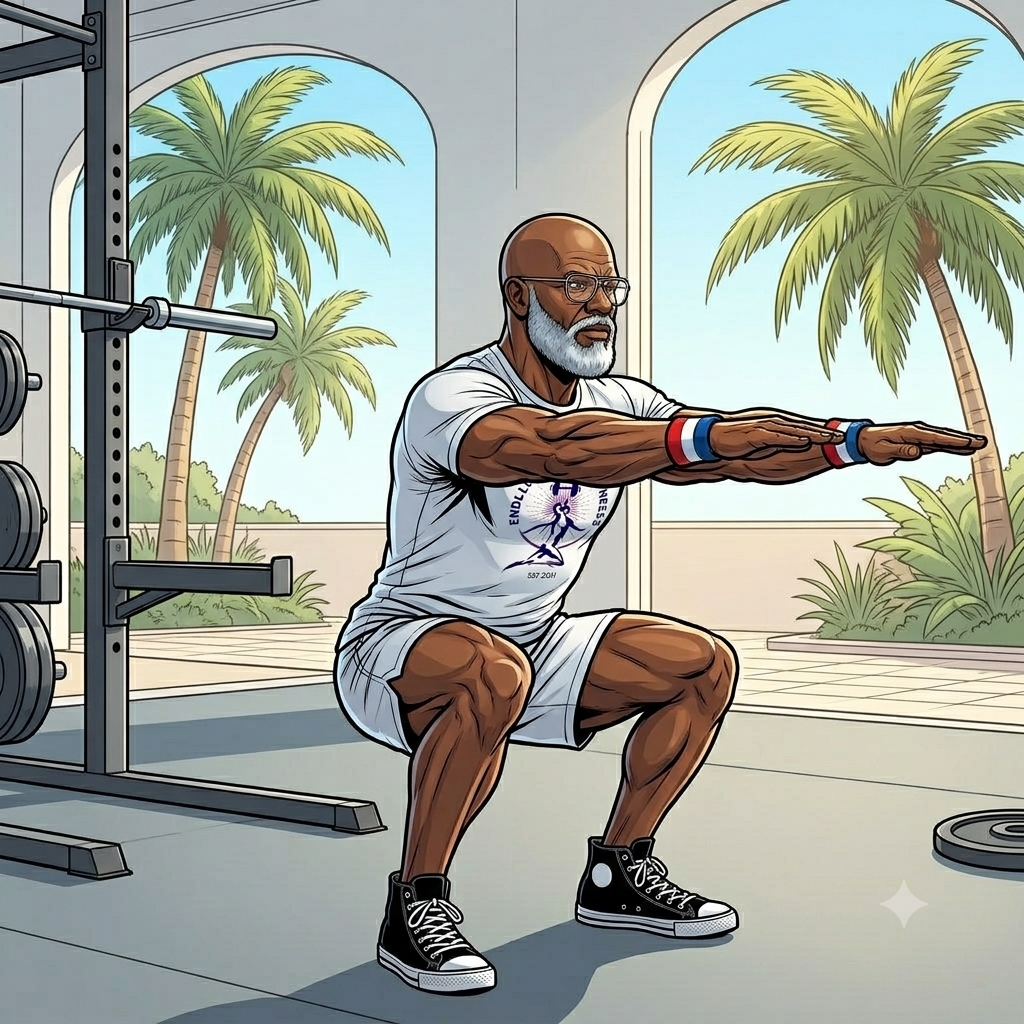
- Deep Squat to Stand (Hamstring Flossing): 12 reps.
- Full World’s Greatest Stretch: 10 reps per side.
- Single-Leg Romanian Deadlift (Bodyweight Flow): 12 reps per side.
Muscles Worked: Glutes, Hip Flexors, Rhomboids, Erector Spinae, Calves. Stabilizers Involved: Core (Transverse Abdominis), Rotator Cuff, Pelvic Floor, Foot Arches.
Your Journey Begins Here
- Struggling with post-desk fatigue? How to Start Working Out After 40: Safe, Beginner-Friendly Guide for Real Results.
- Want to build strength without joint pain? Strength Training for Beginners with No Equipment
Summary
Implementing a Beginner Mobility Routine to Reduce Stiffness is the most effective strategy for maintaining a high quality of life as you age. For desk workers over 40, these movements serve as a necessary “rest” for the damage caused by prolonged sitting.
By focusing on the spine and hips, you allow your body to move with the fluid grace required for a hybrid fitness lifestyle. The main takeaway is that stiffness is not a permanent state; it is often just a lack of varied movement.
The benefits of this routine include reduced joint pain, better posture, and improved circulation. These factors combined create a foundation that allows you to continue training harder and longer well into your 60s and 70s. Your next steps are to find a 10-minute window in your workday to perform the Level 1 or Level 2 movements.
Consistency is more important than intensity when it comes to mobility. By making these small adjustments now, you are ensuring that your fitness path finally feels possible and sustainable for decades to come.
Medical Disclaimer: This article is for educational and informational purposes only and does not constitute medical advice. Always consult a physician or certified fitness professional before beginning a new exercise program, especially if you have pre-existing conditions.