
If you’re over 40, your goals at the gym need to shift. The days of chasing raw muscle size just to fill out a t-shirt or maxing out a bench press without a care for your joints are behind you. What good is a biceps peak if putting your carry-on luggage into the overhead bin makes your shoulder tweak for three weeks? When you are over 40 you need to understand the difference between functional strength vs. muscle mass.
Pour yourself a protein shake and let’s get straight to the point.
We need to talk about the difference between functional strength and muscle size, and why combining both, without destroying your knees or lower back, is the secret to staying capable, pain-free, and strong for decades to come.
Are you ready to make the next step? Read: 5 Essential Moves to Build Over-40 Strength and Stamina
The Real Difference: Useful Movement vs. Tissue Size
Let’s clear up the confusion right off the bat.
Functional strength is your nervous system’s ability to coordinate muscles to move real-world loads through natural paths. Think about carrying three bags of groceries up a flight of stairs, picking a heavy bag of topsoil off the driveway, or twisting to grab a runaway dog leash.
When you train for functional strength, you improve:
Joint stability: Keeping your knees, hips, and shoulders tracking safely under load.
Balance and coordination: Preventing stumbles and maintaining foot-ground connection.
Movement efficiency: Doing everyday tasks using less effort and causing less fatigue.
Muscle size (hypertrophy), on the other hand, refers to the physical cross-sectional area of your muscle fibers. You need raw muscle tissue, especially as you age. Starting around age 30, we naturally lose muscle mass every decade if we don’t actively fight it.
Holding onto muscle tissue gives you:
Metabolic protection: Larger, active muscles handle glucose better and support a healthy metabolic rate.
Joint armor: Bigger, stronger muscles act as shock absorbers for your cartilage and bones.
Reserve force: When you need to push a broken-down lawnmower up a hill, muscle tissue provides the power engine.
You don’t have to choose between moving well and keeping your muscle. You need both.
Why Kettlebell Flows Make Sense for the Over-40 Body
Traditional bodybuilder training isolates single muscles using machine tracks. That’s fine for targeting an isolated spot, but it ignores how your body works as an integrated system. Powerlifting, meanwhile, subjects your spine to massive axial loads that often require days of painful recovery.
Enter the kettlebell flow.
A kettlebell flow links two or three low-impact, multi-joint movements together in one continuous, fluid sequence without setting the weight down. Instead of pounding your joints with heavy barbell reps, you move a manageable load through multiple planes of movement.
Why is this a game-changer for someone over 40?
1. Spinal-Sparing Strength: You get a massive dynamic workout without compressing your lower back under hundreds of pounds.
2. Time Efficiency: You train strength, mobility, and cardiovascular conditioning simultaneously in a twenty-minute session.
3. Connective Tissue Resilience: Tendons and ligaments take longer to adapt and heal as we age. Smooth flow transitions load connective tissue progressively, building resilient joints without the jarring impact of jumps or high-shear lifts.
The Joint-Friendly Kettlebell Flow Blueprint
Forget about complex acrobatics or elite-level circus tricks. To build strength that carries over to real life, you only need master-level control over simple, fundamental human movement patterns: hinging, squatting, pushing, pulling, and rotating.
Here are three joint-friendly flows designed specifically to build usable strength, protect your back, and preserve muscle after 40.
Perform these with a light-to-moderate kettlebell where form remains rock-solid.
[ Hinge / Squat ]
│
▼
[ Transition / Clean ]
│
▼
[ Press / Carry / Lunge ]
Flow 1: Horn Grip Goblet Squat → Suitcase March
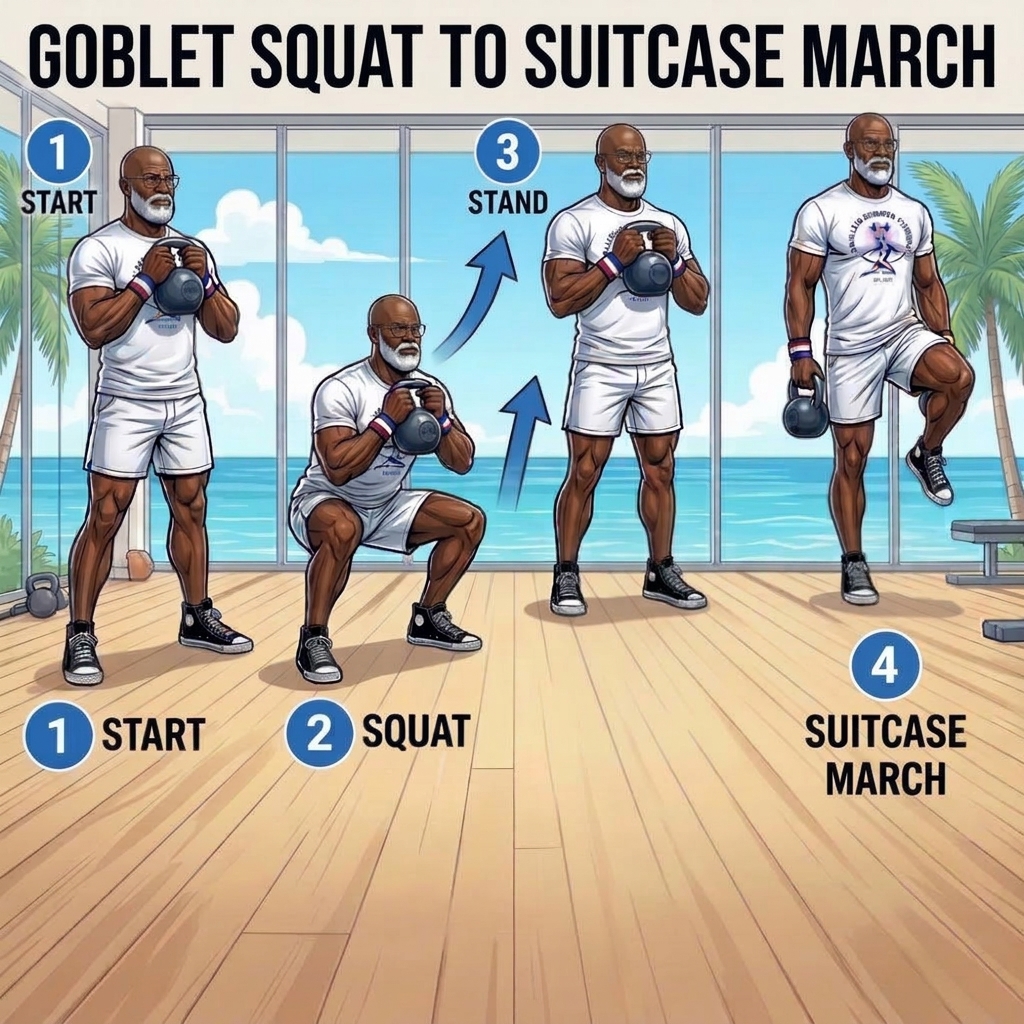
Goal: Lower-body power, knee health, and core stability.
How to do it:
1. Stand tall, holding the kettlebell by its horns right against your chest.
2. Set your feet slightly wider than hip-width, sit your hips down between your knees, and lower into a controlled squat. Go only as low as your hips allow without rounding your lower back.
3. Drive through your heels to stand back up tall.
4. Lower the bell down to your right side, holding it like a heavy briefcase.
5. Brace your abdominal wall and march in place for six total slow, deliberate steps (three per leg). Resist the urge to side-bend toward the weight.
6. Switch the weight to the left hand, repeat the march, then bring the bell back to your chest to start the next rep.
Strength Coach Note: The march forces your deep core stabilizers to clamp down and protect your lumbar spine while your body deals with an asymmetrical load—just like carrying a heavy bag of ice with one hand.
Flow 2: Goblet Lateral Step-Lunge → Box Squat
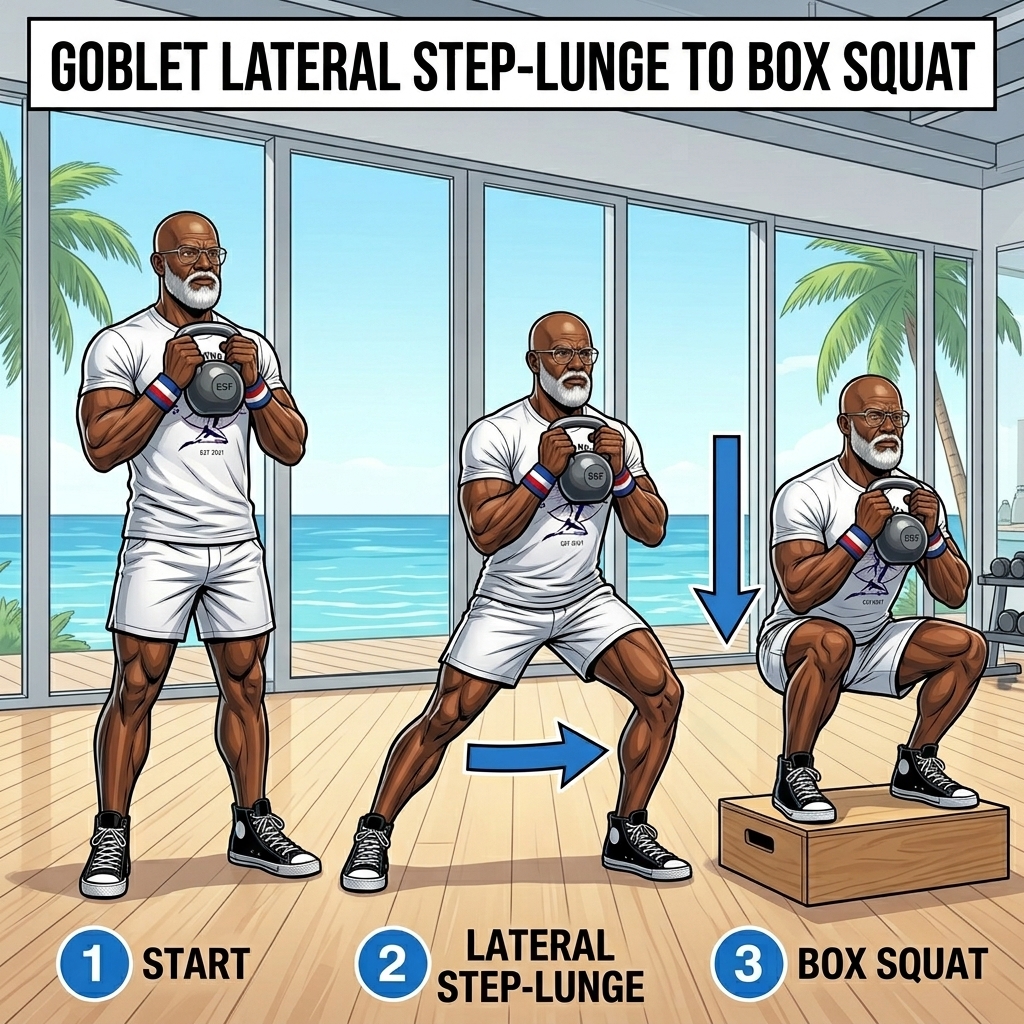
Goal: Hip mobility, lateral stability, and groin strain prevention.
How to do it:
1. Hold the kettlebell close to your chest in the goblet position.
2. Step wide to your right, keeping your left leg straight and both feet pointing straight ahead. Sit your hips back into your right heel to perform a lateral lunge.
3. Push off the right foot firmly to return to the center.
4. Immediately sit your hips back and down into a squat, lightly touching your glutes to a sturdy chair or bench behind you before pressing back to standing.
5. Repeat the sequence, stepping out to the left side on the next rep.
Strength Coach Note: Most adults over 40 only move forward and backward. Moving sideways strengthens the gluteus medius, stabilizing your pelvis and taking uneven strain off your lower back.
Flow 3: Dead Clean → Reverse Lunge
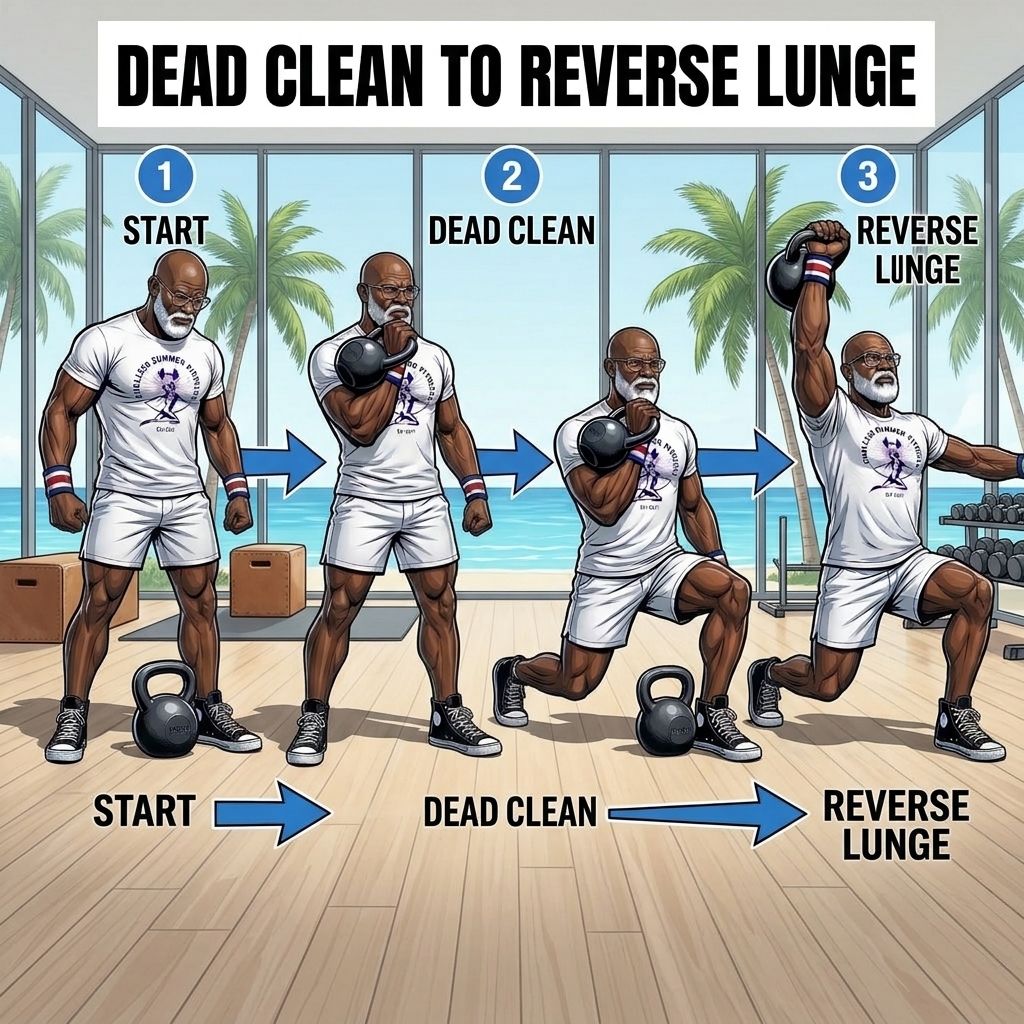
Goal: Posterior chain strength, hip extension, and single-leg balance.
How to do it:
1. Place the kettlebell on the floor between your feet.
2. Hinge at your hips with a flat back, grip the handle, and snap your hips forward to “clean” the bell up smoothly into the front-rack position against your shoulder.
3. Pausing with the bell settled securely against your chest, take a controlled step backward with your right leg and lower your back knee toward the floor into a reverse lunge.
4. Drive through your front heel to stand up tall.
5. Lower the bell safely back to the floor between your feet, reset your grip, and repeat on the opposite side.
Strength Coach Note: Forward lunges put unnecessary shear stress on aging kneecaps. Reverse lunges keep the load on your glutes and hamstrings, protecting the front of your knee joint.
Recovery and Frequency Rules for Long-Term Success
Training hard is only half the equation. Over 40, your ability to recover dictates how much progress you actually keep.
1. The Warm-Up vs. Cool-Down Protocol
Never jump straight into kettlebell work cold. Spend 5 to 7 minutes doing dynamic preparation: bodyweight hip hinges, arm circles, cat-cow stretches, and ankle circles. You need to circulate synovial fluid to lubricate your joints before loading them. Save your static stretching—holding a muscle stretch for 30 to 60 seconds—for after the session when your muscle tissue is warm and receptive.
2. Frequency and Volume
You do not need to train five or six days a week to see results. Three well-executed kettlebell flow sessions per week, spaced with a rest day in between, provides the exact stimulus required to build muscle and improve systemic functional strength. On your off days, walk. Walking is the single best low-impact recovery tool available for managing stress and keeping joints fluid.
Summary
Building a body that works well isn’t about choosing between functional strength and muscle size. You need the muscle engine to produce force and protect your bones, but you need functional movement patterns to ensure that force transfers into everyday life without injuring your joints.
Ditch the ego, put away the hyper-aggressive high-impact routines, and focus on clean, controlled kettlebell movement chains. Prioritize joint position over load, respect your recovery, and stay consistent. Your 60-year-old self will thank you.
Frequently Asked Questions
1. Are kettlebell flows safe if I have past lower-back issues?
Yes, provided you keep the weight moderate and prioritize hip-hinging mechanics over spine bending. Because kettlebell flows rely on momentum and continuous movement rather than maximal static weight, axial loading on the spine is significantly reduced.
2. How heavy should my kettlebell be to start?
Start lighter than you think you need. For most men over 40 starting out, a single 12 kg (26 lb) or 16 kg (35 lb) kettlebell is plenty to master the movement transitions without compromising form.
3. Can kettlebell flows replace traditional cardiovascular exercise?
They certainly can cover your heart-health needs. Because flows keep your body moving continuously through multi-joint patterns without long rest intervals, your heart rate stays elevated in a safe, productive aerobic zone throughout the session.
References
-
Muscle Mass Loss and Aging (Sarcopenia):
-
Resistance Training & Joint Health in Older Adults:
-
Kettlebell Exercise Biomechanics & Low Back Health:
Medical Disclaimer: This article is for educational and informational purposes only and does not constitute medical advice. Always consult a physician or qualified healthcare provider before starting any new exercise routine, particularly if you have pre-existing joint or cardiovascular conditions.*