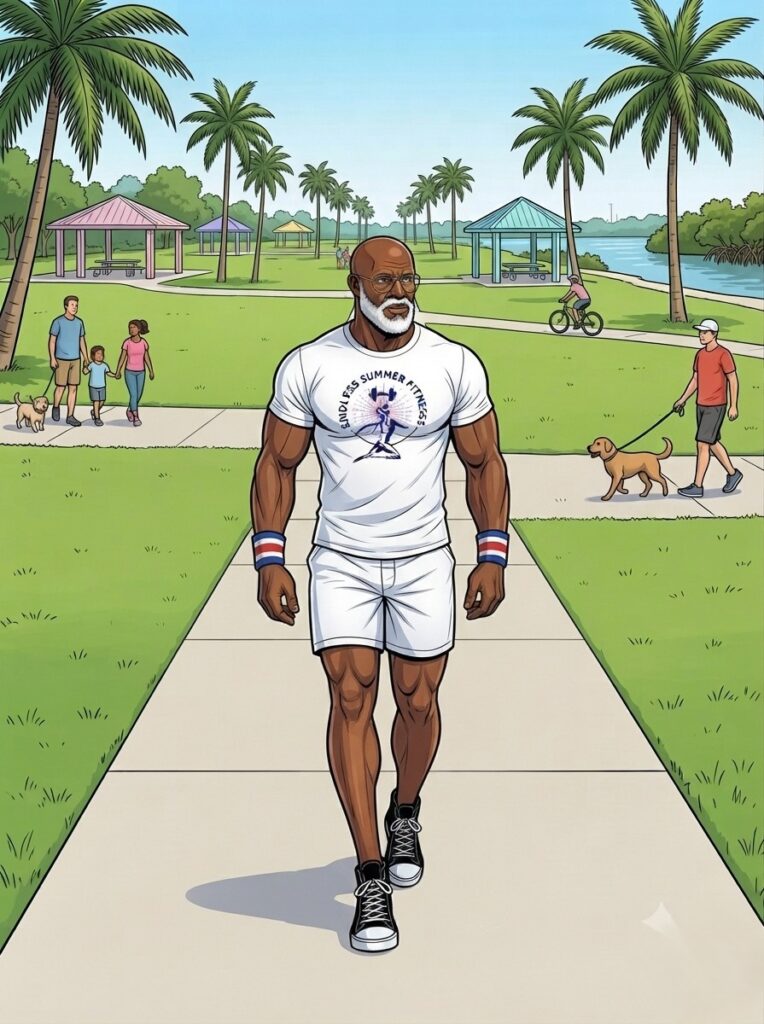
Starting a fitness routine often feels like standing at the foot of an intimidating hill. You might worry about hurting your knees, flaring up lower back stiffness, or getting dragged into extreme programs that leave you exhausted. If you love the outdoors, the simplest and most effective starting line sits right outside your front door. Warm weather is not required. All you need are a walkable terrain, and accessible park trails or sidewalks to make your city, town, or village an ideal laboratory for building physical capability without breaking your body down.
- Before diving into this guide, check out our companion piece on outdoor training:
How to Start a Hybrid Fitness Routine Using Miami’s Best Parks
Many popular fitness routines push an all-or-nothing mindset. You are told to pick a side: either log endless miles running on hard pavement or grind through intense weightlifting sessions indoors. That binary approach fails most adults looking for long-term health. Combining purposeful walking with low-impact strength work builds a heart that pumps efficiently, joints that move smoothly, and muscles that support daily life. You do not need to push until you collapse to make progress. Consistency, intelligent exercise choices, and proper movement mechanics carry you far further than sheer effort.
The Physiology of Walking and Joint-Friendly Adaptation
Walking is far more than a casual way to pass the time. It serves as a foundational movement pattern that conditions your cardiovascular system while keeping joint stress minimal.
Cardiovascular Efficiency and Bone Density
When you take a brisk walk, your heart pumps blood through a vast network of vessels, delivering oxygen to working muscles without the heavy pounding associated with running. This steady mechanical stress acts as a signal to your skeleton. Your bones respond to the gentle force of your foot strike by retaining mineral density, particularly through your hips and lower spine.
For someone getting back into exercise after a long pause, this gentle load stimulates joint tissue without overwhelming your tendons or ligaments. Connective tissue adapts slower than muscle tissue because blood flow to tendons is naturally lower. Gentle, repetitive walking gives your cartilage and ligaments time to toughen up safely.

Dynamic Movement Prep vs. Static Stretching
How you start your walk dictates how your body feels during and after. Sitting for hours leaves your hips tight and your trunk stabilizers asleep. Stepping right out into a fast pace without preparation forces cold joints to absorb unnecessary friction.
Holding static stretches before you move does not warm up your joint capsules. Instead, start with dynamic preparation. Spending three to five minutes performing gentle leg swings, trunk rotations, and high-knee marches raises your core body temperature. It signals your joints to produce synovial fluid, which acts as a natural shock absorber for your knees, hips, and lower back. Save relaxed, static stretches for after your session when your muscles are warm and ready to release tension.
The Hybrid Progression: Building Strength Alongside Stamina
Progressing your fitness does not mean moving into high-impact jumping or extreme barbell loads. Real progress comes from taking a solid walking foundation and adding smart bodyweight and resistance exercises that protect your spine.
Phase 1: Foundational Stability
This phase establishes basic cardiovascular conditioning while teaching your body to move against resistance without stressing your knees or lower back.
The 15-Minute Structured Walk
A structured walk focuses on posture and gait mechanics rather than simply hitting a distance target.
Execution:
- Stand tall with your chest lifted slightly and your shoulders relaxed back and down.
- Begin walking at a comfortable pace where you can easily hold a conversation.
- Strike the ground lightly with your mid-foot or heel, rolling through to push off your toes.
- Swing your arms naturally from your shoulders rather than bending rigidly at the elbows.
- Maintain this steady rhythm for 15 straight minutes on flat ground.
Coaching Tip:
Avoid staring directly down at your feet. Keep your eyes focused 15 to 20 feet ahead to keep your neck alignment neutral and your airway wide open.
The Wall Push-Up
Wall push-ups build upper body strength through your chest, shoulders, and arms without loading your wrists or back with your full body weight.
Execution:
- Stand facing a clear wall, roughly arm-length away.
- Place your hands flat on the wall at shoulder height and slightly wider than your chest.
- Step your feet back a few inches so your body leans forward at a slight angle.
- Brace your torso so your body forms a straight line from your ears down to your ankles.
- Bend your elbows over a three-second count to lower your chest toward the wall.
- Stop when your face is a few inches from the wall, then push firmly back to the starting position.
Complete 10 to 12 controlled repetitions.
Coaching Tip:
Keep your elbows angled down toward your sides at roughly a 45-degree angle. Avoid flaring them straight out sideways, which pinches the front of your shoulder joint.
The Box Squat to a Chair
Squatting to a stable surface teaches proper hip hinge mechanics while removing the fear of losing balance or straining your knees.
Execution:
- Stand in front of a sturdy chair or bench with your feet shoulder-width apart.
- Point your toes slightly outward to match your natural hip angle.
- Reach your arms out front for balance, push your hips back, and sit down slowly.
- Let your thighs touch the seat lightly without releasing your body weight completely.
- Press your feet firmly through the middle of your foot and heel to stand tall.
Complete 8 to 10 smooth repetitions.
Coaching Tip:
Do not let your knees collapse inward as you stand up. Push your knees outward so they track in a straight line over your middle toes.
Phase 2: Functional Resistance
Once you establish a consistent walking habit, adding external resistance like dumbbells or bands keeps your muscles challenged and your posture strong.
The Brisk Interval Walk
Interval walking alternates between your normal walking speed and a faster pace to safely elevate your heart rate.
Execution:
- Walk at a comfortable, warm-up pace for 5 minutes.
- Pick up your speed to a brisk pace—as if you are rushing to catch a bus—for 1 minute.
- Return to your comfortable recovery pace for 2 minutes.
- Repeat this 1-minute fast, 2-minute easy cycle 4 times.
- Walk at an easy pace for 3 minutes to cool down.
Coaching Tip:
Focus on taking shorter, quicker steps rather than over-striding. Reaching your front leg too far out acts like a brake, sending unwanted forces up into your shin and knee.
The Supported Goblet Squat
Holding a light dumbbell or kettlebell against your chest acts as a counterweight, helping you keep your spine upright while loading your leg muscles.
Execution:
- Stand tall holding a light weight vertically against the center of your chest with both hands.
- Set your feet shoulder-width apart with a slight toe flare.
- Brace your abdominal wall as if preparing for a light tap to the stomach.
- Push your hips back and lower down into a squat, keeping your chest lifted.
- Descend only as far as you can comfortably control without your lower back rounding.
- Push through your feet to drive back up to the top.
Perform 8 to 10 clean repetitions.
Coaching Tip:
Keep the weight glued to your chest throughout the set. Letting the weight drift forward pulls your torso down and puts unnecessary strain on your lower back.
The Standing Resistance Band Row
Pulling exercises strengthen the postural muscles between your shoulder blades, counteracting the forward-hunching posture caused by sitting and driving.
Execution:
- Anchor a medium resistance band securely around a sturdy post or door anchor at chest height.
- Hold one handle in each hand and step back until you feel light tension.
- Stand with your feet hip-width apart and a soft bend in your knees.
- Pull the handles toward your lower ribs, squeezing your shoulder blades together at the back of the movement.
- Hold the contraction for one second.
- Slowly extend your arms forward over a three-second count to return to the start.
Complete 10 to 12 reps.
Coaching Tip:
Initiate the movement by moving your shoulder blades first, not by pulling with your hands. Keep your shoulders down away from your ears to avoid neck tension.
Navigating Miami’s Environment: Heat and Outdoor Strategy
Training outdoors in South Florida offers incredible scenic views, but heat and humidity require intelligent management to keep your workouts safe.
Heat Mitigation and Hydration
High humidity prevents sweat from evaporating efficiently, making it harder for your body to cool down. Staying ahead of dehydration requires drinking water before you head out, not just when you feel thirsty.
Time Your Walks: Schedule outdoor sessions before 8:30 AM or after 7:00 PM to avoid peak solar heat.
Choose Shaded Routes: Seek out park paths with tree canopies or ocean breezes rather than unshaded asphalt streets.
Dress for Airflow: Wear loose, light-colored clothing made of synthetic, moisture-wicking fabrics rather than heavy cotton.
Carry Water: Bring a small hand-held bottle for any walk lasting longer than 20 minutes in warm weather.
Summary FAQs
How many steps should a beginner aim for each day?
A solid starting benchmark for someone returning to activity is 4,000 to 5,000 steps daily. Focus on adding consistent movement throughout your day rather than stressing over a single large distance. Once that base feels easy, increase your daily total by 500 steps each week until you comfortably reach 8,000 to 10,000 steps.
Can I build strength and lose weight just by walking?
Walking burns calories and improves your metabolic health, but pairing it with basic resistance exercises delivers better long-term results. Strength training preserves your muscle tissue while you drop body fat, ensuring that your metabolism stays strong and your joints stay supported as you lose weight.
What are the best places for beginner walking workouts in Miami?
Look for flat surfaces with wide paths and reliable shade. The Miami Beach Boardwalk offers ocean breezes and smooth footing. Inland locations like Tropical Park or Fairchild Tropical Botanic Garden provide paved loops surrounded by shade trees, making them comfortable options for hot mornings.
Do I need gym equipment to get started with hybrid fitness?
You do not need a gym membership or expensive machinery. A pair of supportive walking shoes, your own body weight, a sturdy chair, and a simple resistance band are more than enough to complete effective workouts for your first several months.
How do I protect my lower back while starting a routine?
Protecting your lower back comes down to avoiding repetitive spinal bending under load. Choose exercises that keep your spine neutral, like wall push-ups, chair squats, and resistance band rows. Always warm up your hips before walking so your pelvis moves freely without pulling on your lower back.
Medical Disclaimer: This article is for educational and informational purposes only and does not constitute medical advice. Always consult a physician or qualified healthcare professional before starting a new exercise program, especially if you have pre-existing joint issues, cardiovascular conditions, or are recovering from an injury.
References
-
American College of Sports Medicine. (2021). ACSM’s Guidelines for Exercise Testing and Prescription (11th ed.). Lippincott Williams & Wilkins.
-
Hall, G. K., et al. (2020). The Association Between Daily Step Count and All-Cause Mortality in Older Adults. PubMed / National Institutes of Health.
-
Lieberman, D. E. (2015). Is Exercise Really Medicine? An Evolutionary Perspective on Walking, Endurance, and Health. Sports Medicine, 45(Suppl 1), 3-10.