Kettlebells offer a straightforward way to build useful strength in a small space. Unlike traditional dumbbells, where weight is balanced evenly on both sides of a central handle, a kettlebell hangs below its horn. That offset weight forces your core muscles, forearms, and shoulders to work continuously just to stabilize each repetition.
The issue with many standard kettlebell plans is their reliance on rapid, explosive movement. For anyone managing joint stiffness or previous knee and lower back issues, throwing heavy weights around under speed creates unnecessary risk.
By focusing on slow, deliberate repetition speed and relying on stable floor or bench support, you unlock all the muscular benefits of kettlebell training while keeping your joints protected.
Three Pillars of Safe Training
- Slow Down the Lowering Phase: Spend 3 full seconds lowering the weight on every single rep. Letting gravity pull the weight down deprives your muscles of work and puts sudden shock on your tendons.
- Keep the Spine Fixed: Keep your back straight from your neck to your hips. Avoid twisting movements while holding a weight, which puts direct pressure on your lower spine.
- Earn the Right to Heavy Weights: Choose a weight that lets you complete every rep with crisp form. Muscle burning is a good sign; joint pain means the load or angle needs to change immediately.
The Foundation Routine
Perform this workout 2 or 3 times a week. Complete 3 sets per exercise, resting 45 to 60 seconds between sets.
Warm-Up (5 Minutes)
- Arm Circles: 60 seconds forward and backward
- Hip Hinge Practice: 60 seconds (knees slightly bent, pushing hips back toward the wall behind you)
- Marching in Place: 3 minutes at an easy pace
Foundation Exercises
1. Bench-Supported Goblet Squat
- Volume: 3 sets of 12–15 reps
- Speed: 3 seconds lowering, 1-second pause at the bottom, 1 second standing up
- How to do it: Stand facing away from a sturdy chair or bench with your feet slightly wider than your shoulders. Hold the kettlebell close to your chest by the sides of the handle. Sit back slowly over 3 seconds until your hips touch the seat, then press through your mid-foot to stand back up without snapping your knees straight.
2. Single-Arm Suitcase Deadlift
- Volume: 3 sets of 12–15 reps on each side
- Speed: 3 seconds down, 1 second up
- How to do it: Place the kettlebell on the floor next to your right foot. Bend your knees, hinge at the waist with a flat back, and grip the handle. Stand tall by pushing through your feet, keeping your shoulders square so you do not lean to one side. Lower the kettlebell back down under strict 3-second control. Complete all reps on the right before switching sides.
3. Supine Floor Chest Press
- Volume: 3 sets of 12–15 reps
- Speed: 3 seconds lowering, 1 second pressing up
- How to do it: Lie on your back on a padded mat with your knees bent and feet flat. Hold the kettlebell in your right hand, letting the round weight rest against the back of your forearm. Lower your elbow down over 3 seconds until your upper arm lightly touches the floor, then press the weight straight up toward the ceiling.
4. Two-Handed Standing Row
- Volume: 3 sets of 12–15 reps
- Speed: 1 second pulling up, 1-second hold, 3 seconds lowering
- How to do it: Stand with your feet hip-width apart, holding the handle with both hands. Bend forward at your hips until your upper body is at a 45-degree angle, keeping your spine straight. Pull the weight toward your stomach by driving your elbows backward, squeeze your upper back muscles, then lower it over 3 seconds.
5. Opposite Arm & Leg Extensions (Bird-Dog)
- Volume: 3 sets of 8–10 reps per side
- Speed: 2-second hold at extension, 3 seconds returning to start
- How to do it: Get on your hands and knees on your mat. Raise your right arm straight ahead while lifting your left leg straight behind you until both are level with your body. Hold for 2 seconds, lower back down under control, and switch to the opposite arm and leg.
Cool-Down (5 Minutes)
- Standing Hamstring Stretch: 60 seconds per leg
- Doorway Chest Stretch: 60 seconds per side
- Child’s Pose: Hold for 2 minutes while taking slow, deep breaths
The Progressive Routine
Move to this workout once you have mastered the movement patterns above. Perform 3 to 4 sets per movement with 45 to 60 seconds of rest between sets.
Warm-Up (5 Minutes)
- Side-Step Touches: 2 minutes (stepping side-to-side while swinging arms)
- Gentle Torso & Shoulder Mobility: 3 minutes
Progressive Exercises
1. Goblet Step-Back Lunge
- Volume: 3–4 sets of 10–12 reps per leg
- Speed: 3 seconds lowering, 1 second stepping up
- How to do it: Stand straight with the kettlebell held against your chest. Step backward with your right foot and lower your body over 3 seconds until your back knee is an inch off the floor. Push off your front foot to return to the starting position. Complete all reps on your right leg before switching to your left.
2. Unilateral Floor Press
- Volume: 3–4 sets of 12–15 reps per arm
- Speed: 3 seconds lowering, 1 second pressing up
- How to do it: Lie on your back with knees bent. Hold the kettlebell in your right hand with your arm straight up. Lower your elbow to the floor over a full 3 seconds while resting your left arm flat on the ground for balance. Press the bell straight up without letting your wrist tilt backward.
3. Single-Arm Bench Row
- Volume: 3–4 sets of 12–15 reps per arm
- Speed: 1 second pulling up, 1-second hold, 3 seconds lowering
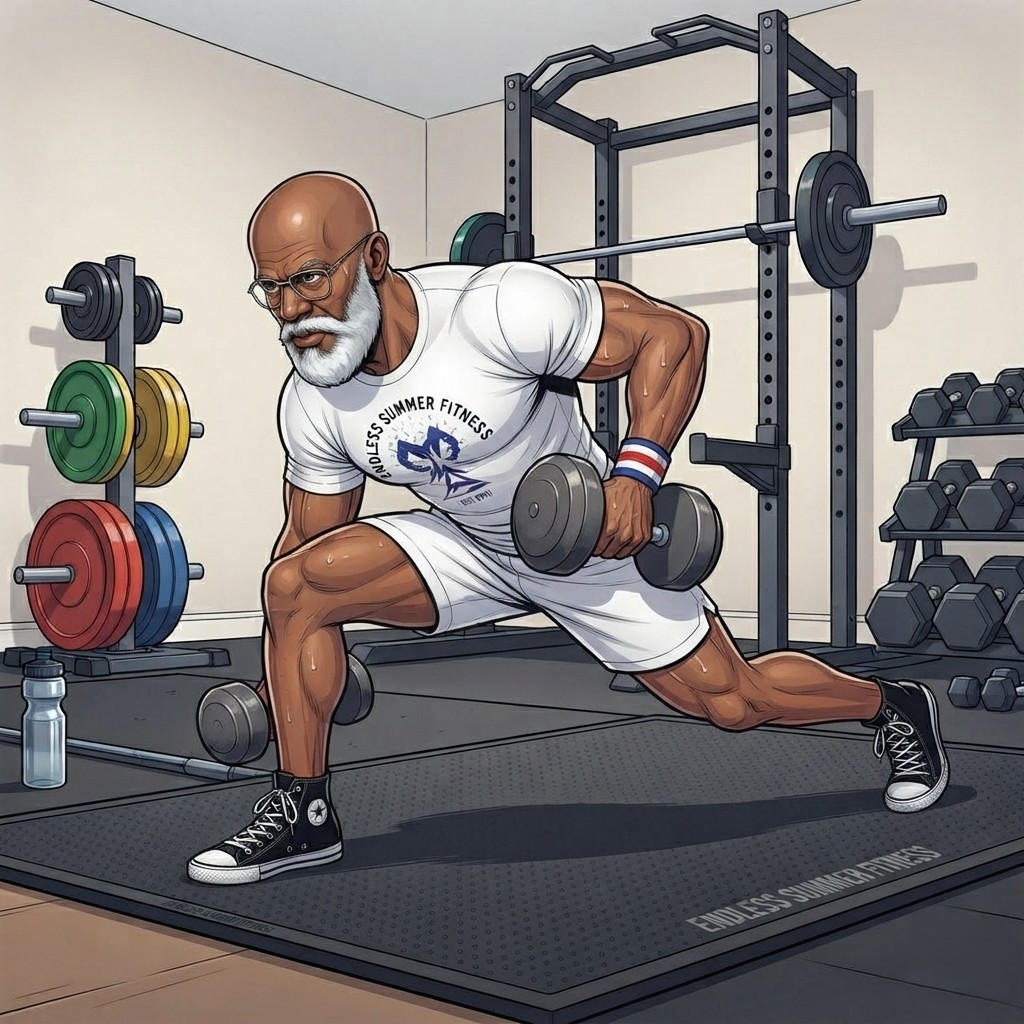
- How to do it: Place your left knee and left hand flat on a bench or chair. Hold the kettlebell in your right hand with your arm hanging down. Pull the handle up toward your hip pocket, pause for a second, then lower it back down under 3-second control.
4. Half-Kneeling Shoulder Press
- Volume: 3–4 sets of 10–12 reps per arm
- Speed: 1 second pressing up, 3 seconds lowering
- How to do it: Kneel on your mat with your right knee down and left foot flat on the floor in front. Hold the kettlebell at your right shoulder. Keep your stomach tight and press the weight straight overhead until your elbow locks out. Lower it back to your shoulder over 3 seconds.
5. Two-Handed Straight Press-Out
- Volume: 3–4 sets of 12–15 reps
- Speed: 2-second hold at full extension, 3 seconds returning to chest
- How to do it: Stand tall with your feet shoulder-width apart, holding the kettlebell against your chest by its side handles. Press the weight straight out in front of your chest without leaning back or rounding your shoulders. Hold for 2 seconds, then pull it back to your chest.
Cool-Down (5 Minutes)
- Seated Hamstring Stretch: 60 seconds per leg
- Standing Quad Stretch: 60 seconds per leg
- Child’s Pose: Hold for 2 minutes
Long-Term Training Rules
- Prioritize Control Over Load: Never increase the weight if it forces you to rush reps, swing your body, or arch your lower back.
- Give Connective Tissue Time to Rest: Muscles adapt faster than tendons. Maintain a structured routine and take at least one full day off between workouts.
- Stay Active Daily: Resistance training works best when paired with daily movement like walking to keep your joints healthy and circulating blood efficiently.
Summary
You do not need to perform high-speed swings or explosive moves to get a great kettlebell workout. Staying grounded, moving at a strict 3-second speed, and working through manageable rep ranges builds muscle, grip strength, and core stability safely at home.
Peer-Reviewed References & Standards
-
American College of Sports Medicine (ACSM)
Guideline: Strength and Resistance Standards for Healthy Adults.
Takeaway: Recommends performing controlled resistance exercises 2 to 3 times per week to improve muscle retention and joint integrity as you age.
Link: ACSM Exercise Guidelines -
National Strength and Conditioning Association (NSCA)
Guideline: Joint-Spairing Protocols in Exercise Selection.
Takeaway: Recommends using floor and bench support to limit joint hyper-extension during pressing and pulling exercises.
Link: NSCA Resource Library -
Journal of Biomechanics
Study: Spinal Loading During Low-Back and Abdominal Exercises (McGill, S.)
Takeaway: Confirms that non-rotational core holds activate abdominal muscles effectively while keeping compressive stress on lumbar discs low.
Link: PubMed Spine Research
Medical Disclaimer: This article is for educational purposes only and does not constitute medical advice. Consult your healthcare provider before beginning any new exercise routine.