Starting a strength routine requires balancing muscular activation with connective tissue recovery. For beginners or individuals returning to exercise, lifting heavy weights with explosive speed increases joint stress and risk of injury. We provide the full guide: Beginner Full-Body Workout Plan for Joint Strength.
To build functional capacity safely, this protocol utilizes high volume, continuous tension, and strict 3-second eccentric tempos. By controlling movement velocity and prioritizing floor-supported or bodyweight exercises, you maximize strength gains while protecting your shoulders, lower back, and knees.
Core Execution Rules
- The 3-Second Eccentric Rule: Lower every weight or return from every extension over a full 3-second count. This eliminates momentum, increases time-under-tension, and builds tendon resiliency without heavy loading.
- Floor-Supported Positioning: Floor-based variations natural cap joint range of motion, preventing shoulder hyper-extension and lumbar hyper-lordosis.
- Controlled Breathing: Inhale during the lowering (eccentric) phase and exhale during the pushing/pulling (concentric) phase. Never hold your breath during resistance.
The Full-Body Beginner Routine
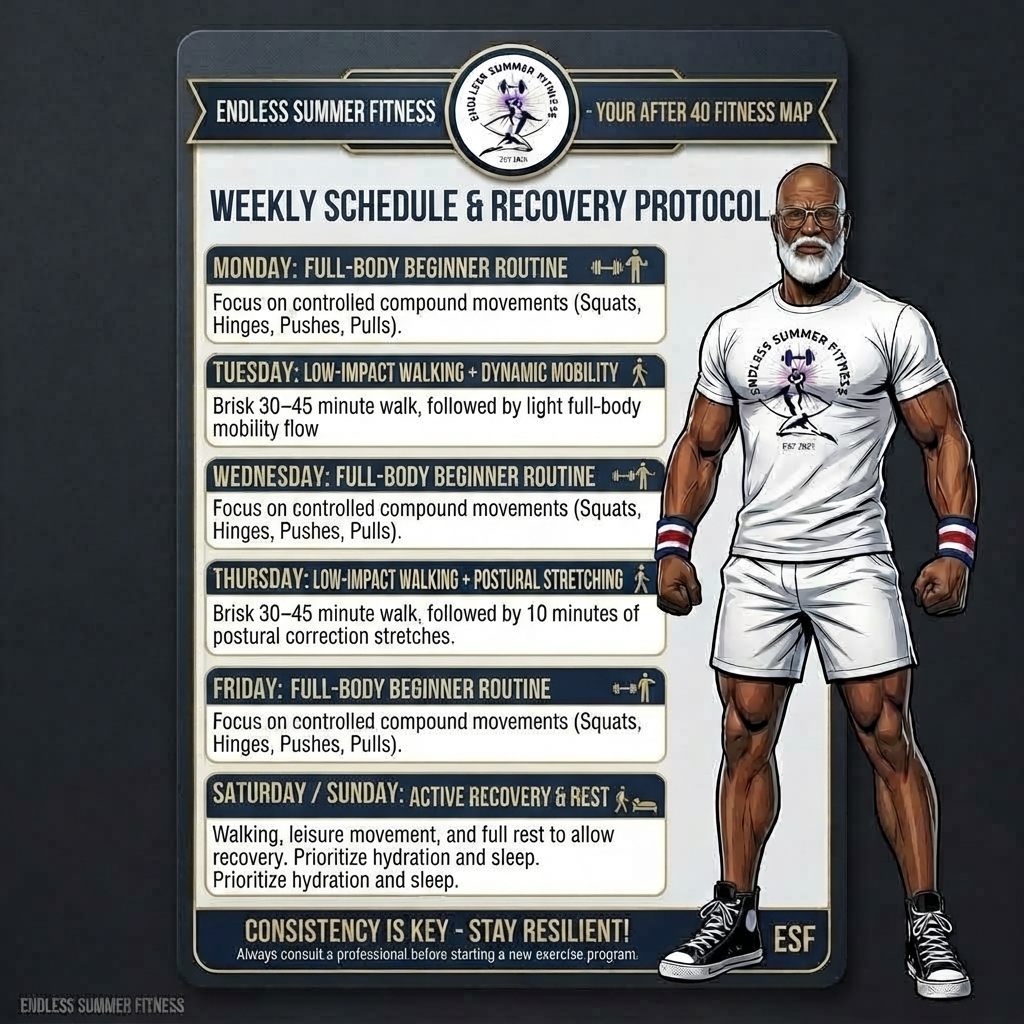
Perform this routine 3 non-consecutive days per week (e.g., Monday, Wednesday, Friday). Rest 60 seconds between sets.
1. Dumbbell or Bodyweight Box/Chair Squat
Reinforces proper hip-hinge mechanics while protecting patellar tendons.
- Volume: 3 sets of 12–15 repetitions
- Tempo: 3-second lowering phase, 1-second touch pause, 1-second stand
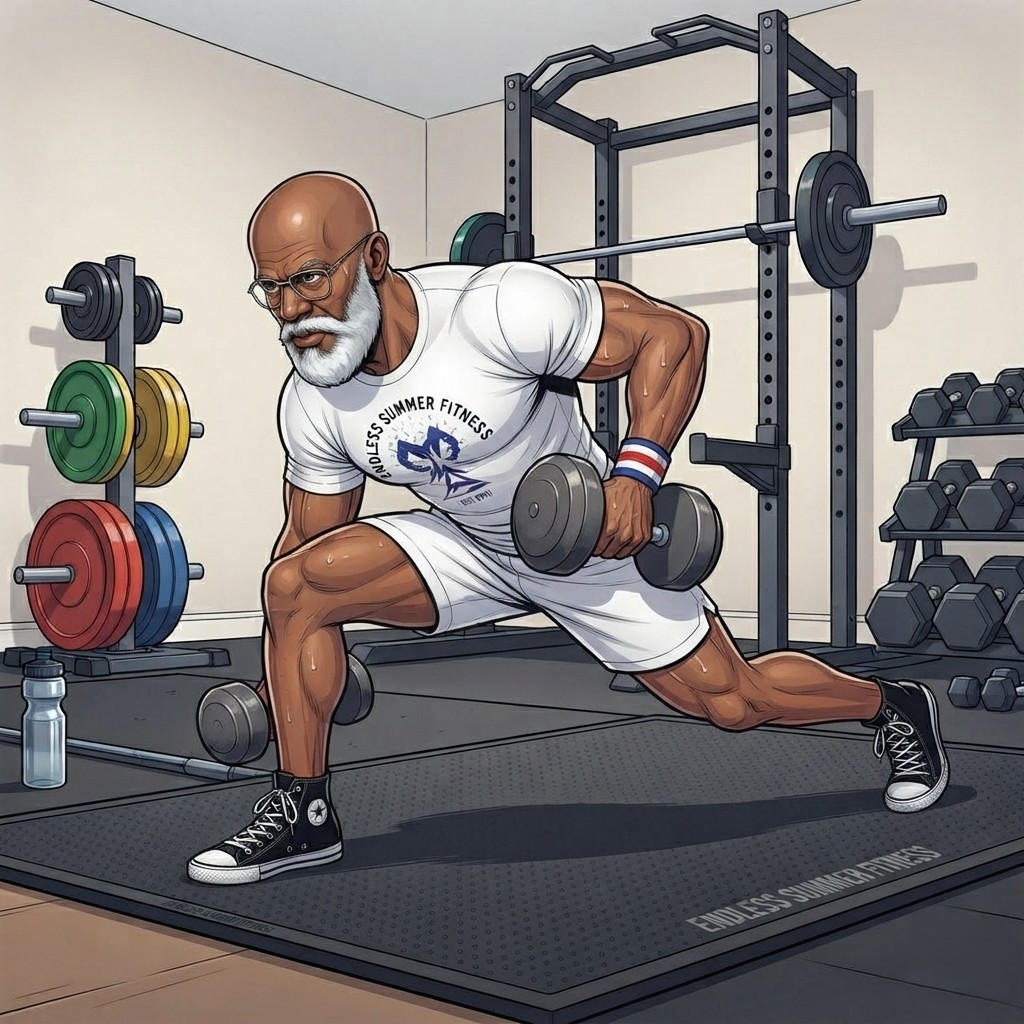
- Execution: Stand in front of a sturdy chair or bench with feet shoulder-width apart. Hinge at the hips and sit back slowly over 3 seconds until your glutes lightly touch the seat. Drive through your mid-foot and heels to return to standing without locking out your knees abruptly.
2. Incline Push-Up (Wall or Bench Supported)
Develops chest, shoulder, and triceps pressing strength while protecting the lower back and shoulder joints.
- Volume: 3 sets of 10–12 repetitions
- Tempo: 3-second lowering phase, 1-second press
- Execution: Place your hands slightly wider than shoulder-width apart on a sturdy elevated surface (wall, counter, or bench). Maintain a rigid plank position from head to heels. Lower your chest under control over 3 seconds until elbows reach a 45-degree angle to your torso, then press back to the starting position.
3. Resistance Band Seated or Standing Row
Strengthens the posterior deltoids, rhomboids, and mid-trapezius to support posture.
- Volume: 3 sets of 12–15 repetitions
- Tempo: 1-second pull, 1-second squeeze, 3-second return
- Execution: Anchor a loop band around a secure object or around your feet while seated. Hold the handles with arms extended. Drive your elbows back close to your ribs, squeezing your shoulder blades together. Control the return phase over a strict 3-second count against band resistance.
4. Glute Bridges
Activates gluteal muscles and hamstrings while relieving tension in the lumbar spine.
- Volume: 3 sets of 15 repetitions
- Tempo: 1-second lift, 2-second top squeeze, 3-second lowering
- Execution: Lie flat on your back on a mat with knees bent and feet flat on the floor, hip-width apart. Drive through your heels to raise your hips until your thighs and torso align. Squeeze your glutes at the top for 2 seconds, then lower under control over 3 seconds.
5. Bird-Dog (Spinal-Sparing Core Stability)
Builds anti-rotational core stability and lower-back health without flexing the lumbar spine.
- Volume: 3 sets of 8–10 repetitions per side
- Tempo: 2-second hold at full extension, 3-second return
- Execution: Begin on hands and knees with a neutral spine. Simultaneously reach your right arm forward and extend your left leg straight back until both are parallel to the floor. Hold for 2 seconds, return to center under control, and alternate sides.
Weekly Schedule & Recovery Protocol
References & Scientific Sources
-
American College of Sports Medicine (ACSM)
Guideline: Physical Activity and Resistance Training Guidelines for Beginners and Older Adults.
Key Takeaway: Confirms that full-body resistance routines performed 2–3 days per week with 48 hours of rest between sessions optimize muscular adaptation while preventing connective tissue overuse.
Link: ACSM Physical Activity Guidelines -
National Strength and Conditioning Association (NSCA)
Guideline: Exercise Technique and Safety Standards for Novice Lifters.
Key Takeaway: Recommends closed-kinetic-chain and supported movements (such as box squats and incline presses) for novice lifters to establish proper neuromuscular control before introducing heavy loads.
Link: NSCA Education & Performance Resources -
Journal of Biomechanics / PubMed Central
Study: Lumbar Spine Load during Core Stabilization vs. Flexion Exercises (McGill, S.)
Key Takeaway: Demonstrates that isometric core stabilization exercises like the Bird-Dog provide high muscular activation while imposing significantly lower shear forces on intervertebral discs compared to traditional sit-ups or crunches.
Link: PubMed – Spinal Mechanics & Core Stability
Medical Disclaimer: This article is for educational and informational purposes only and does not constitute medical advice. Always consult a physician or certified fitness professional before starting a new exercise program.