In this article, we discuss 7 low-impact HIIT moves to destroy fat while simultaneously putting less stress on your joints.
.Welcome to summer, where the sun is hot, the energy is high, and nobody has time to sit out a training session because their knees are throbbing. If you are over 40, a busy professional, or just getting back into the swing of things, you’ve likely been told that to lose fat, you have to run until your heels scream or jump on boxes until your Achilles snaps.
That is dead wrong!
You do not need to subject your skeleton to high-impact pounding to trigger rapid fat loss. In fact, for long-term consistency and joint longevity, you shouldn’t. Enter Low-Impact High-Intensity Interval Training (HIIT): the ultimate tool to strip body fat, build functional stamina, and keep you moving fast without the wear and tear.
Be sure to read: 5 Hybrid Athlete Principles for Rapid Fat Loss & Strength
Why This Matters for Over-40 Beginners
By the time you cross the 40-year milestone, your body’s recovery capacity changes. High-impact movements, like traditional sprint intervals or jump squats—place massive peak forces on your knees, hips, and lower back.
When you are constantly recovering from joint inflammation, you cannot train consistently. Consistency is the sole driver of fat loss. Low-impact HIIT eliminates the joint-jarring impact forces while keeping your heart rate in the training zone required to spark serious metabolic demand. You get all the cardiovascular and fat-burning benefits of high-intensity training, with none of the downtime.
Simple Biomechanics: High Intensity vs. High Impact
To understand why this works, we have to look at the physics of movement.
-
High Impact refers to movements where both feet leave the ground simultaneously (running, jumping, bounding). Upon landing, your joints must absorb forces equal to 2.5 to 5 times your body weight.
-
High Intensity refers to cardiovascular and metabolic demand, how hard your heart, lungs, and muscles are working. This is measured by oxygen consumption ($VO_2$) and heart rate.
By selecting exercises where at least one foot remains firmly planted on the ground, or by utilizing continuous-tension resistance tools, we keep the impact low. By manipulating execution speed, leverage, and full-body recruitment, we keep the intensity high. Your heart and lungs cannot tell the difference between a high-impact tuck jump and a low-impact, explosive kettlebell swing, but your knees certainly can.
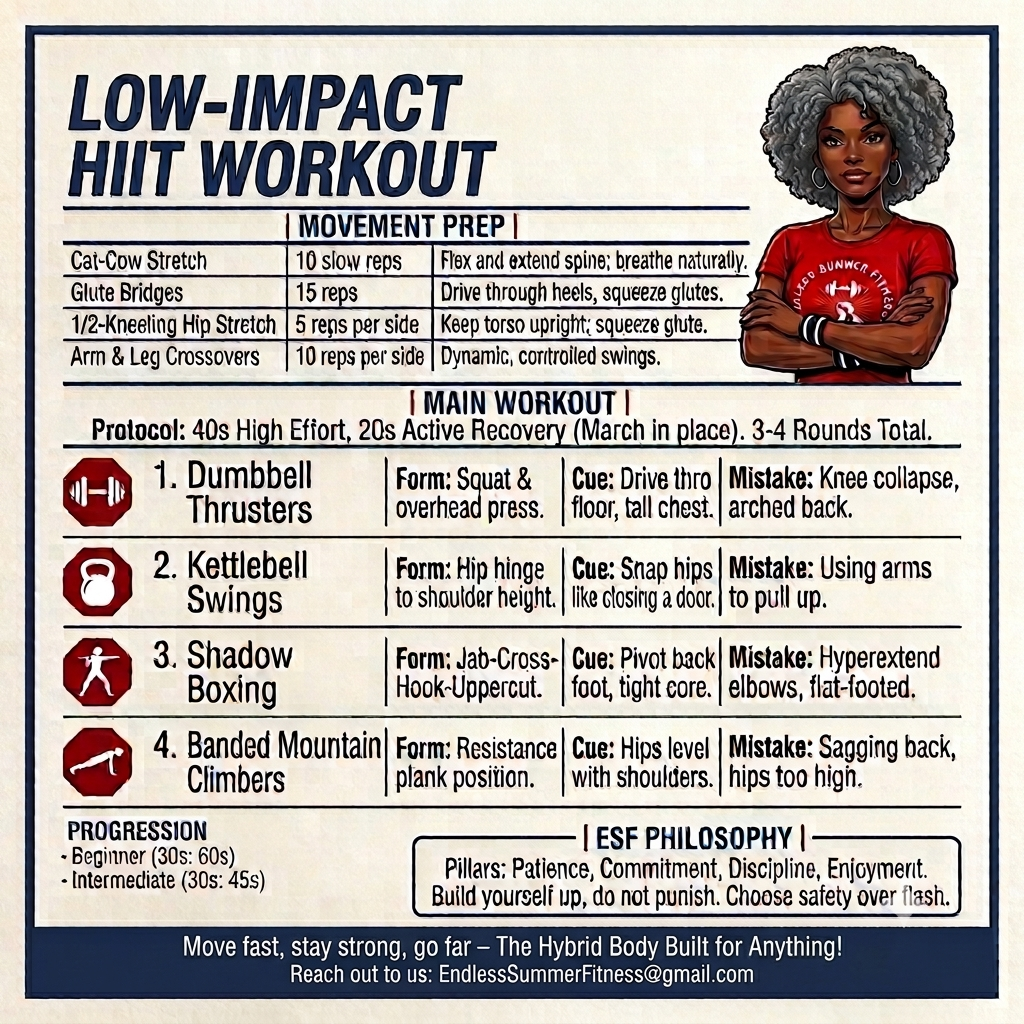
Movement Prep (The Warm-Up)
Never jump straight into high-intensity work cold. Spend 5 minutes preparing your tissues and lubricating your joints.
The Main Low-Impact HIIT Workout
Perform each exercise for 40 seconds of high-effort work, followed by 20 seconds of active recovery (marching in place). Complete 3 to 4 rounds total.
1. Dumbbell Thrusters (Squat to Overhead Press)
-
How to do it: Hold dumbbells at shoulder height. Sit your hips back and down into a controlled squat. As you stand, explosively press the weights overhead using the upward momentum of your legs.
-
Coaching Cue: Drive through the floor. Keep your heels down and your chest tall.
-
Common Mistake: Letting the knees collapse inward or arching the lower back at the top of the press.
2. Kettlebell (or Dumbbell) Swings
-
How to do it: Stand with feet hip-width apart, holding a kettlebell. Hinge at your hips, pushing them back while keeping your spine straight. Explosively snap your hips forward to swing the bell to shoulder height.
-
Coaching Cue: This is a hinge, not a squat. Think of snapping your hips like a car door closing.
-
Common Mistake: Using the arms to pull the weight up instead of driving power from the hips and glutes.
3. Shadow Boxing (Punch Combinations with Fast Footwork)
-
How to do it: Adopt an athletic stance. Throw fast, controlled jab-cross-hook-uppercut combinations into the air while maintaining active, quick steps.
-
Coaching Cue: Pivot on your back foot when throwing the cross. Keep your core tight.
-
Common Mistake: Hyperextending the elbows on punches or standing completely flat-footed.
4. Banded Mountain Climbers
-
How to do it: Secure a resistance band around your feet. Assume a strong push-up plank position. Alternately drive your knees toward your chest against the resistance of the band.
-
Coaching Cue: Keep your hips level with your shoulders. Do not bounce up and down.
-
Common Mistake: Sagging the lower back or raising the hips too high in the air.
Beginner to Intermediate Progression
To progress this routine, we do not add heavier weights or demand unstable, high-impact jumps. Instead, we alter variables that respect your joint integrity:
-
Beginner: Perform 30 seconds of work with 30 seconds of rest. Focus entirely on nailing the slow, controlled eccentric phase of each movement.
-
Intermediate: Move to 45 seconds of work with 15 seconds of rest. Increase the execution speed of the concentric phase (the push or snap) while maintaining absolute control.
ESF Philosophy Integration
This routine is built directly on our core pillars: Patience, Commitment, Discipline, and Enjoyment.
Losing fat over 40 isn’t about punishing your body for what you ate yesterday. It is about committing to movements that build you up rather than tear you down. Discipline means choosing the safer, highly effective low-impact variation over the flashy high-impact move just because you saw it on social media. Have the patience to master the form, and you will actually enjoy the process because you won’t be nursing an injury next week.
Medical Disclaimer: This article is for educational and informational purposes only and does not constitute medical advice. Always consult a physician or certified fitness professional before beginning a new exercise program, especially if you have pre-existing conditions.
If you believe in something, never give up! 12 months can change your life!
Need professional guidance to tailor your joint-friendly training? Reach out to us at [email protected].
Peer-Reviewed Sources
-
Effects of Low-Impact High-Intensity Interval Training on Body Composition and Cardiovascular Health in Older Adults (Journal of Sports Science & Medicine)
-
Comparison of Joint Loading Forces Between High-Impact and Low-Impact Aerobic Modalities (Clinical Biomechanics)
-
Metabolic Demand and Excess Post-Exercise Oxygen Consumption (EPOC) in Low-Impact Resistance-Based Interval Training (Medicine & Science in Sports & Exercise)