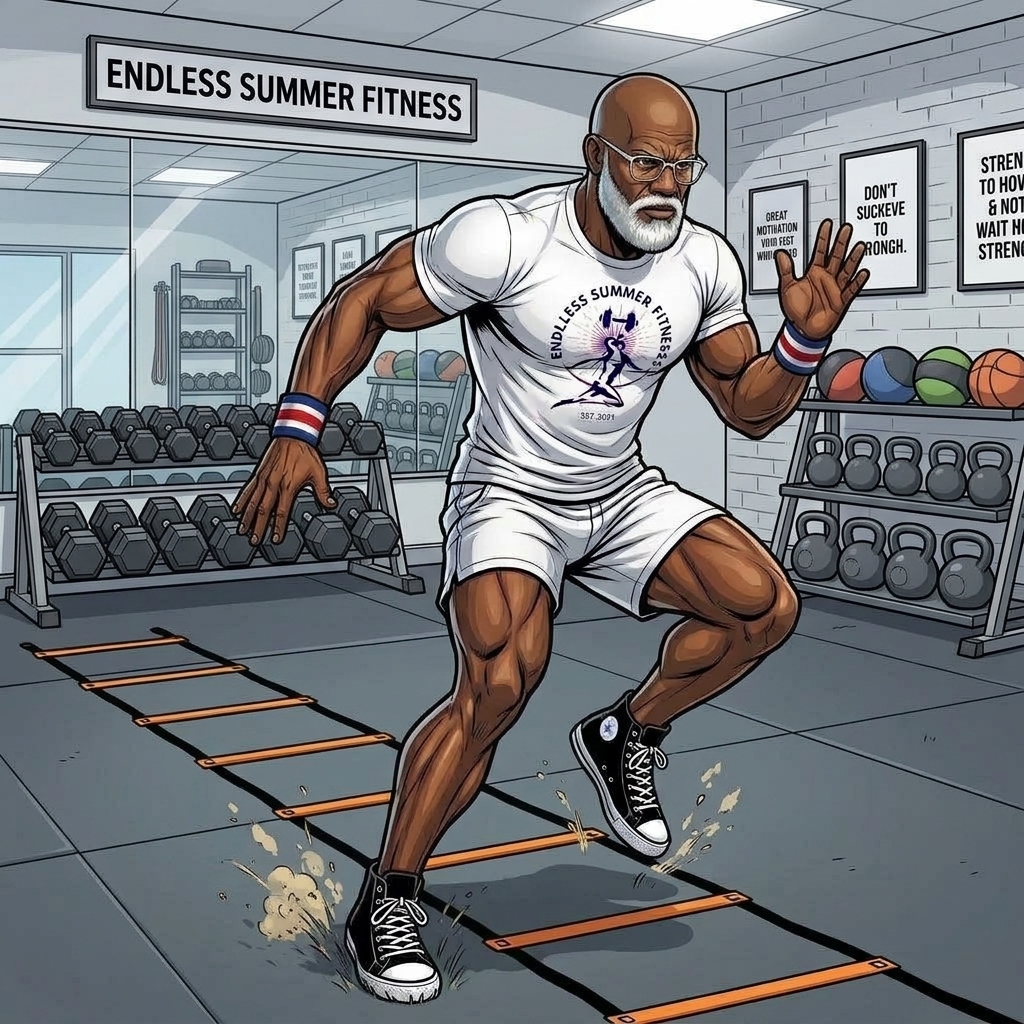

Building explosive lower-body power is essential for athletic performance, vertical jump height, and sprint speed. However, plyometrics and high-velocity movements are not conventional continuous cardio—they are neuromuscular power exercises that require controlled volume, proper landing mechanics, and complete recovery to prevent joint stress and tendon overload. Here are 9 lower-body power exercises to improve your athletics.
The following guide outlines the top exercises for lower-body explosiveness, along with structural guidelines to program them safely and effectively.
Power & Athletic Performance Movements
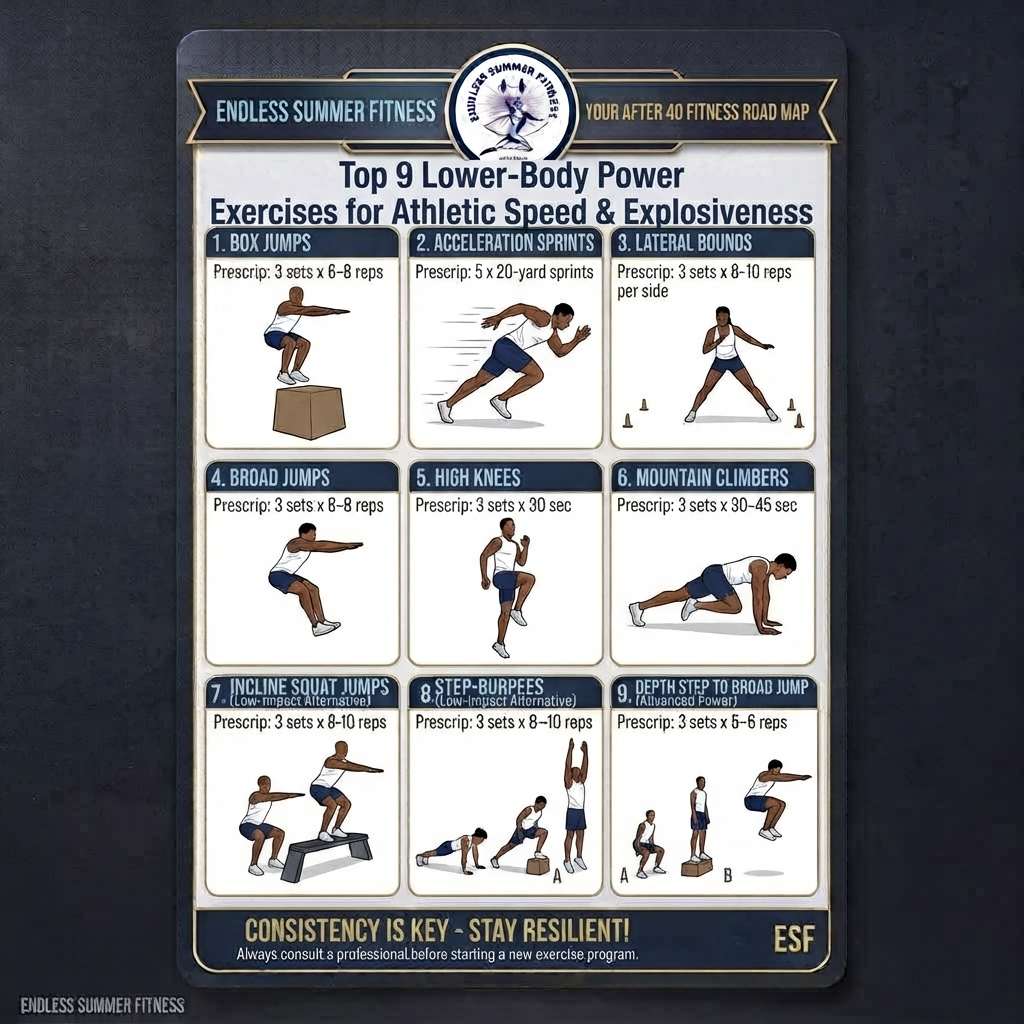
1. Box Jumps
Box jumps develop explosive hip extension while reducing landing impact compared to ground-based plyometrics.
- Volume: 3–4 sets of 3–5 repetitions (focus on maximal effort, not endurance).
- Execution: Stand facing a sturdy, stable box. Hinge at the hips, swing arms back, and explosively jump onto the platform, landing softly in a partial squat with full foot contact. Step down manually—never jump backward off the box.
2. Acceleration Sprints
Short-distance sprints train maximal power output and rate of force development (RFD) across the entire lower body.
- Volume: 4–6 reps of 10–30 meters with full recovery (60–90 seconds) between runs.
- Execution: Begin in a staggered stance. Drive hard through the front mid-foot, maintaining a forward torso angle during the acceleration phase before gradually uprighting.
Sprints Warm-Up Protocol
Proper preparation readies the central nervous system and prepares tendons for high velocity:
- Dynamic Mobility: Perform leg swings, hip openers, and walking lunges to prepare joint range of motion.
- Ankle & Calf Prep: Complete low-amplitude pogo hops and ankle circles to increase Achilles tendon stiffness.
- Glute & Core Activation: Perform glute bridges and lateral band walks to engage hip extensors.
- Technique Drills: Execute high-knee A-skips and bounding to reinforce efficient force application.
- Sub-Max Accelerations: Complete 2–3 short runs at 50%, 70%, and 80% effort before attempting 100% max-velocity sprints.
3. Lateral Bounds (Side-to-Side Jumps)
Lateral bounds build single-leg power, hip stability, and change-of-direction agility in the frontal plane.
- Volume: 3 sets of 5–6 reps per side.
- Execution: Push off the outside foot to bound laterally, landing softly on the opposite leg with knee and hip flexed to absorb force before leaping back.
4. Broad Jumps
Broad jumps develop horizontal power production across the glutes, hamstrings, and calves.
- Volume: 3 sets of 3–5 repetitions.
- Execution: Stand with feet shoulder-width apart, hinge back into a quarter-squat, and swing arms forward as you leap horizontally. Land softly with knees aligned over toes and absorb impact through the hips.
5. High Knees (Dynamic Warm-Up / Drill)
A functional running drill that strengthens hip flexors and reinforces rapid leg turnover.
- Volume: 3 sets of 15–20 seconds.
- Execution: Maintain an upright torso and pump arms in opposition as you drive knees up toward hip height, landing lightly on the balls of your feet.
6. Mountain Climbers
A low-impact core stability drill that reinforces pelvic control during dynamic hip flexion.
- Volume: 3 sets of 30 seconds.
- Execution: Hold a rigid forearm or hand plank position. Drive knees toward the chest alternately without letting the hips bounce or sag.
7. Incline Squat Jumps (Low-Impact Alternative)
A joint-friendly variation of plyometric jumping that builds explosive vertical drive.
- Volume: 3 sets of 5–8 repetitions.
- Execution: Perform on an incline or smooth surface, descending into a partial squat and driving upward through mid-foot and toes. Land softly with soft knees to absorb landing forces.
8. Step-Burpees (Low-Impact Full-Body Movement)
Replaces high-impact drop-burpees to condition total-body stamina while protecting wrists, shoulders, and the lower back.
- Volume: 3 sets of 8–10 repetitions.
- Execution: From a standing position, place hands on the floor, step feet back into a solid plank, step feet back in, and stand tall with a arm reach overhead.
9. Depth Step to Broad Jump (Advanced Power)
An advanced method to train the stretch-shortening cycle (SSC) for maximum reactive power.
- Volume: 3 sets of 3–4 repetitions.
- Execution: Step off a low step (6–12 inches), absorb the landing briefly, and instantly explode forward into a broad jump.
Programming & Recovery Guidelines
- Power Requires Recovery: Explosive movements demand maximal neural output. Do not perform plyometrics to exhaustion or as high-rep cardio; rest 60–90 seconds between sets to maintain power output.
- Frequency: Schedule explosive lower-body training 2–3 times per week on non-consecutive days to allow 48 hours of tendon and joint recovery.
- Quality Over Quantity: Stop sets when velocity or landing mechanics degrade.
References & Scientific Sources
-
National Strength and Conditioning Association (NSCA)
Guideline: Essentials of Strength Training and Conditioning (4th Ed.) — Plyometric Exercise Mechanics and Prescription.
Key Takeaway: Confirms that high-velocity plyometrics must be trained with low repetition ranges and complete rest intervals to maximize neuromuscular power rather than metabolic endurance.
Link: NSCA Education & Performance Resources -
American College of Sports Medicine (ACSM)
Guideline: Progression Models in Resistance Training for Healthy Adults.
Key Takeaway: Details recovery requirements for power development, recommending 48–72 hours between intense plyometric or sprint sessions for connective tissue synthesis.
Link: ACSM Official Guidelines -
Journal of Sports Science & Medicine
Study: Effects of Plyometric Training on Vertical Jump Performance and Sprint Speed (Markovic, G.)
Key Takeaway: Demonstrates that controlled plyometric exercises significantly improve rate of force development (RFD) and jump performance when landing forces are properly managed.
Link: PubMed – Plyometric Performance Research
Medical Disclaimer: This article is for educational and informational purposes only and does not constitute medical advice. Always consult a physician or certified fitness professional before starting an explosive or high-intensity exercise routine.